



Quick Answer: Is an H Type Broiler Cage System Suitable for 15,000 Chickens in Tanzania?
An H Type Broiler Cage System can be considered for a 15,000-chicken commercial broiler project in Tanzania because the documented LIVI H105-80 model is recommended for farms above 10,000 birds. This is a basis for technical review, not proof of a final layout, cage quantity, investment amount, or operating result.
Planning a 15,000-Bird Tanzania Broiler Project?
Share your site or house dimensions, water and power conditions, broiler target, market route, and automation priorities for a fact-based H-Type project discussion.
Before selecting equipment, confirm the market route, site or poultry-house conditions, water supply, electrical conditions, ventilation approach, manure route, biosecurity workflow, labor plan, and budget boundaries. No verified Tanzania customer, installed layout, shipment, price, performance result, or profitability result has been supplied. The immediate decision is whether the project is ready for a fact-based technical review.
Project Summary
| Item | Confirmed Reference or Current Status |
|---|---|
| Target country | Tanzania |
| Planned flock target | 15,000 broilers |
| Product reference | LIVI H105-80 H-Type Broiler Cage |
| Documented recommendation | Projects above 10,000 birds |
| Customer-case evidence | No verified Tanzania project source supplied |
| Current decision | Validate technical and operating readiness before final configuration |
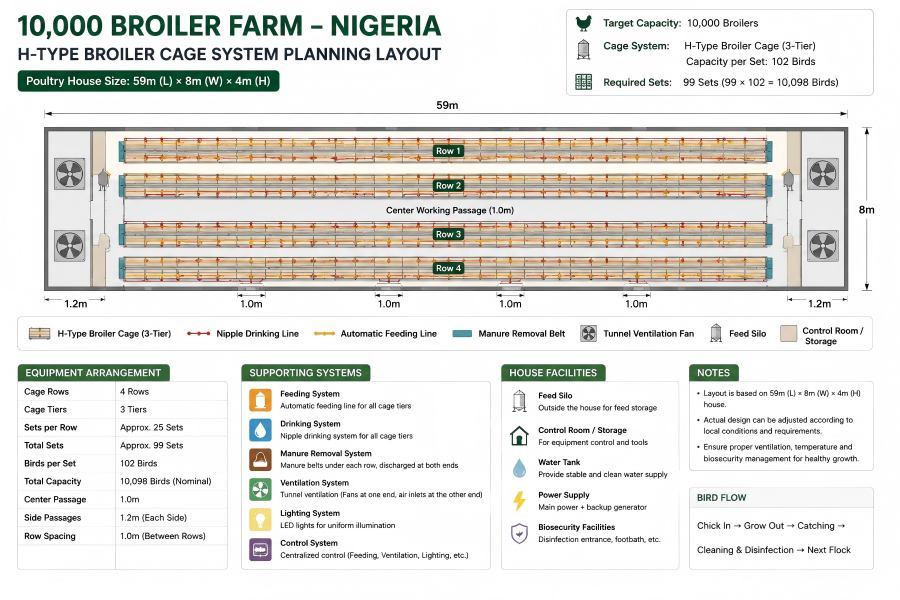
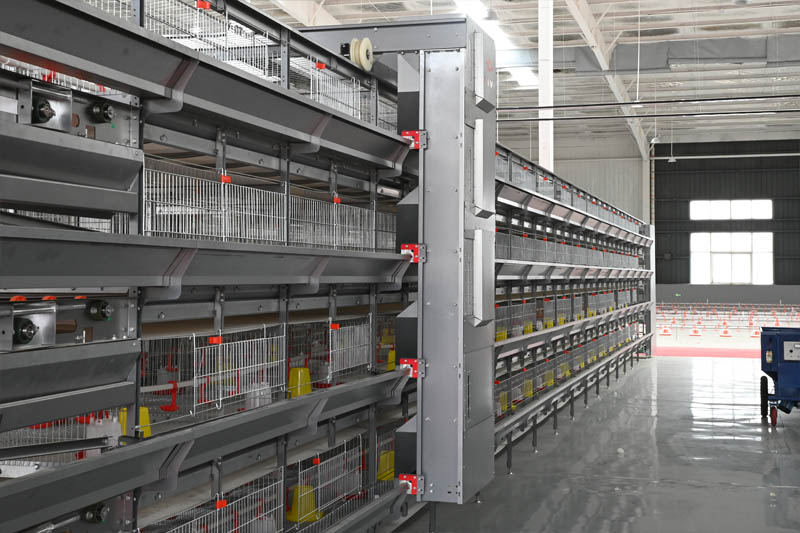
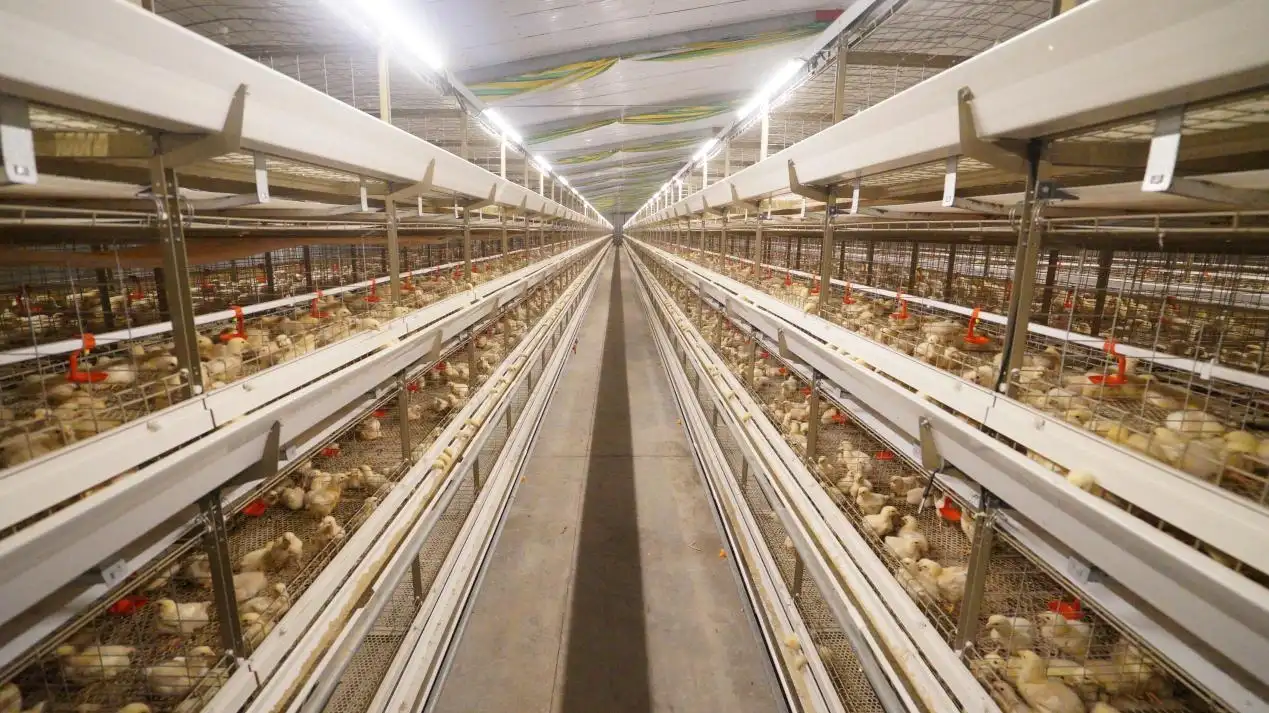
For a 15,000-bird concept, the H Type Broiler Cage System should be assessed as one operating system rather than as a stand-alone cage purchase. Bird flow, feeding, drinking, manure handling, cleaning, maintenance, and sales activities need to work together.
What This Tanzania 15,000-Bird Topic Does Not Yet Prove as a Customer Case
No authorized evidence has been supplied for a named Tanzania customer, farm location, house dimensions, cage quantity, order date, shipment, installation status, flock placement, production data, customer quotation, or commercial result. This topic cannot be presented as a completed Tanzania customer project.
Product specifications and supplier capabilities can help define a review, but they do not prove that a local farm has been built or achieved a result. Facts from projects in other countries are not Tanzania case evidence.
A customer case requires authorized records confirming the project location, flock scale, equipment scope, status, and approved results. Its status should accurately distinguish planning, production, shipped, installing, trial operation, or operating. Until then, this page remains a planning guide for a Tanzania investor.
Documented H Type Broiler Cage System Facts and 15,000-Bird Verification Items
| Planning Item | Documented Product Reference or Required Confirmation | Decision Relevance |
|---|---|---|
| Product model | LIVI H105-80 | Reference for technical discussion |
| Applicable poultry | Broilers | Confirms intended poultry type |
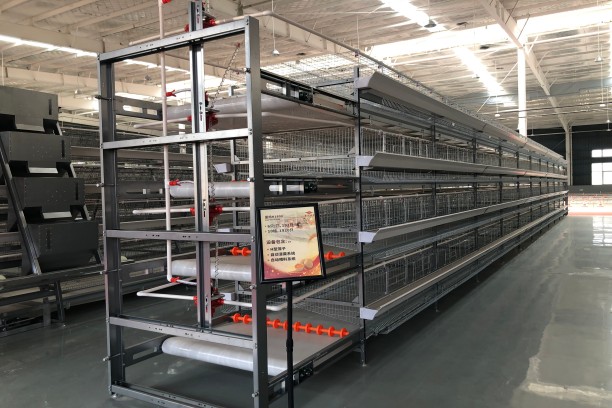
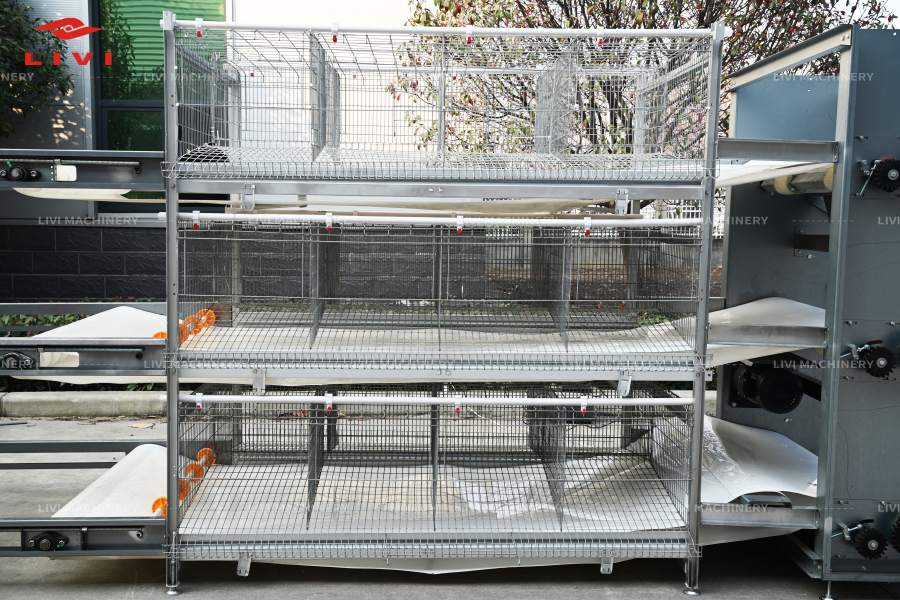
| Cage structure | H-Type Broiler Cage | Requires a site-specific layout |
| Tier arrangement | 3–4 tiers | Review with house and workflow design |
| Capacity reference | 102–136 broilers per set | Not a final project cage quantity |
| Material and treatment | Q235 steel; hot-dip galvanizing | Documented product references |
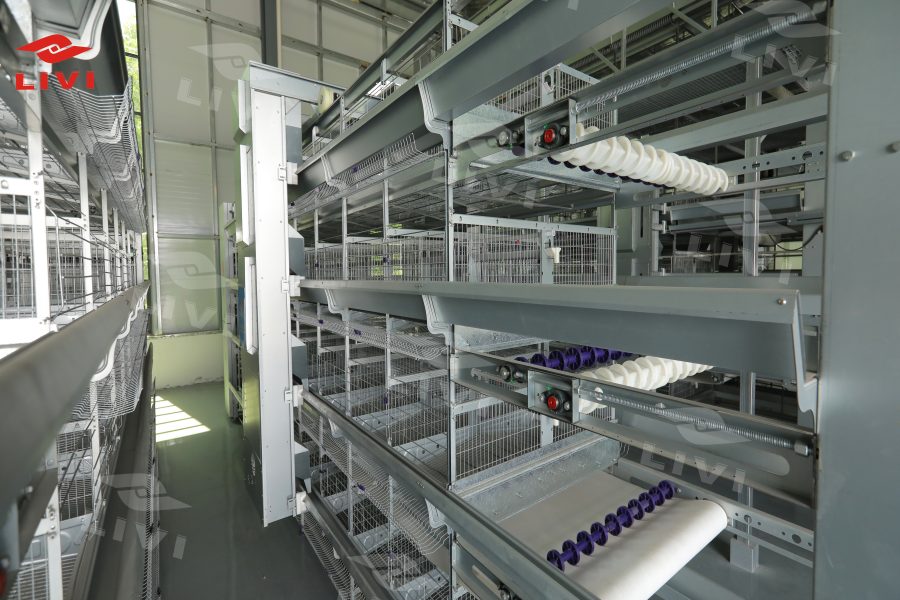
| Feeding and drinking | Trolley-feeder Automatic Feeding; high-configuration Automatic Drinking | Confirm final scope and site interfaces |
| Manure handling | Flat-belt manure removal with transverse and inclined manure removal | Confirm collection and handling route |
| Optional systems | Feed silo, lighting, alarm system, ventilation and temperature system | Optional or configurable, not confirmed for Tanzania |
| Project conditions | House dimensions, water, electricity, delivery, installation, operating plan | Require final confirmation |
The stated 15–20-year service-life reference is a product reference, not a Tanzania-specific warranty, operating-life guarantee, or project result.
What Must Be Decided Before Choosing a 15,000-Bird Broiler Cage Project in Tanzania?
Start with the commercial route. The investor should establish whether the intended sales timing, buyers or processing arrangements, and responsible operating team support the proposed flock target. Equipment selection should follow a clear route from chick placement through broiler sales.
Validate Your Broiler Cage System Requirements
Send your available site details, planned flock size, manure-handling approach, delivery location, and preferred support scope before requesting a final equipment configuration.
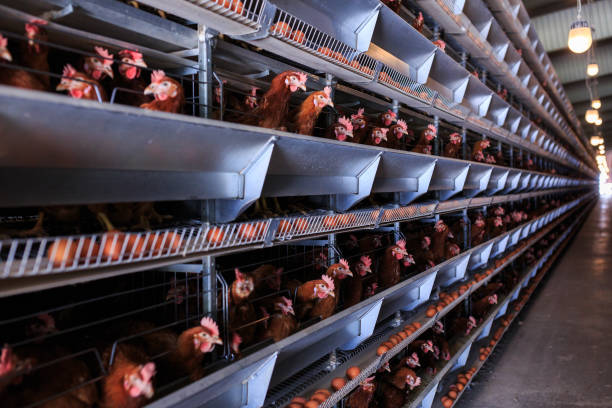
Then review the site or poultry house as an operating system: bird movement, feed handling, water, electrical interfaces, ventilation, manure handling, cleaning access, maintenance access, and biosecurity separation. WOAH guidance on broiler production systems recognizes cage-based broiler production and notes that stocking density should allow normal access to feed and water, movement, and posture. Management capability, housing, ventilation, and biosecurity are among the factors to consider.
The 15,000-bird target is not a final equipment bill. The documented H105-80 recommendation above 10,000 birds does not determine cage-set quantity, house arrangement, optional equipment, or installation sequence. Those items depend on project information that has not been supplied.
Core questions before technical design
- What is the planned broiler sales route and who is accountable for it?
- What are the confirmed site or house dimensions and construction status?
- What water and electrical conditions are available for operation?
- How will ventilation, manure handling, cleaning, and biosecurity be organized?
- Which automation systems are required at the initial stage?
- Who will unload, store, assemble, test, and operate the equipment?
Keep potential expansion separate from the initial 15,000-bird decision. Land, utilities, workflow capacity, and management capability should be assessed for the initial scope before expansion is incorporated into a final design.
How Should Equipment Scope Match the Operating Plan?
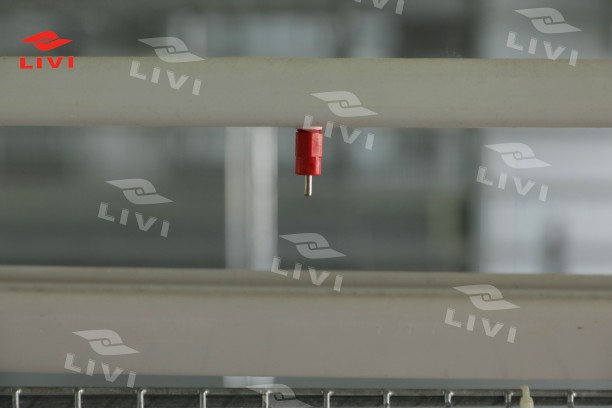
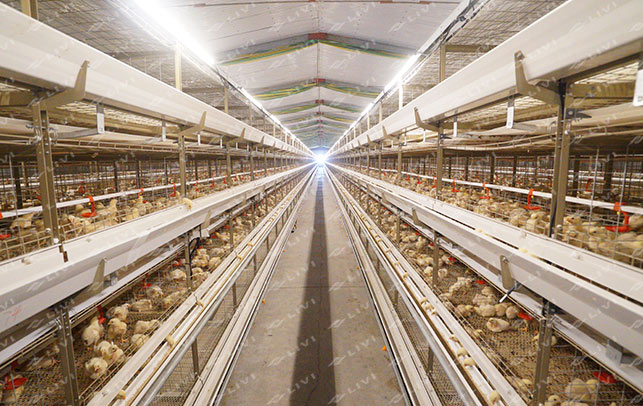
The documented H105-80 configuration includes trolley-feeder Automatic Feeding, high-configuration Automatic Drinking, and flat-belt manure removal with transverse and inclined manure removal. These are documented product features, not confirmation of a Tanzania order scope.
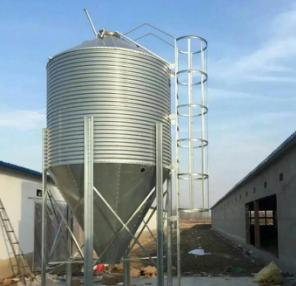
Feed silos, lighting, an alarm system, and ventilation and temperature systems are optional or configurable. Confirm each item only after reviewing the house, operating priorities, utility conditions, and final technical scope. A complete H Type Broiler Cage System requires coordinated cage structure, Feeding System, Drinking System, Manure Removal System, and any selected supporting equipment.
Commercial farms may use more mechanization and automation as scale increases, but management must still provide suitable conditions, clean water, and good-quality feed. FAO management and housing guidance supports this system-level approach. It does not replace the site-specific review for this cage-based broiler project.
A useful request for an Automatic Broiler Cage System should identify the systems needed in the first phase, the intended operators, and the conditions the site can support. This prevents optional equipment from being treated as automatically included.
How Should Delivery and Site Readiness Be Reviewed Before a Tanzania Project Is Released?
LIVI Machinery states that it can organize production, inspection, packaging, container loading, export delivery, packing lists, installation information, equipment instructions, and technical support according to a confirmed order. The company profile also identifies 40HQ and 20GP export-container loading support.
No Tanzania-specific shipment route, container quantity, port, transit time, customs process, freight amount, inland transport plan, or installation completion date has been supplied. These items require confirmation for the individual project.
Before dispatch, confirm the delivery address, import responsibilities, unloading equipment, secure storage, package-checking process, installation sequence, civil-work status, and utility interfaces. Check packages against the packing list and organize them by installation area before assembly.
FAO's poultry housing review notes the importance of avoiding temperature fluctuations in broiler management. This is a general management consideration, not a Tanzania climate claim or a ventilation design for this project.
Recommended implementation sequence
- Confirm market route, flock target, site or house availability, responsibilities, and budget boundaries.
- Provide dimensions, construction status, water, electrical conditions, ventilation approach, manure route, and automation priorities.
- Approve the final layout and equipment scope after technical verification.
- Confirm civil works, utilities, unloading access, storage, and installation responsibilities before dispatch.
- Organize production, inspection, packaging, export documents, and shipment against the confirmed order scope.
- Check packages, assemble according to approved drawings and guidance, and test confirmed systems before operational use.
- Complete operating and maintenance guidance through remote support or, where agreed, on-site engineer support.
What Supplier Capabilities Should Be Verified Before Contracting?
Verify that the supplier can convert confirmed site information into a coordinated equipment scope. LIVI states that it can provide equipment-layout and system-configuration recommendations based on flock size and poultry-house dimensions, and that customization is supported according to farming requirements.
LIVI also states that it has welding, equipment-component, and complete-machine assembly production systems. Its documented quality process covers raw-material, pre-production, post-production, third-party, pre-shipment, outbound, and loading inspection. These are company-level capability references, not evidence of a Tanzania project outcome.
Installation and service boundaries should be confirmed in writing. The supplied information lists installation drawings, operating information, video guidance, remote technical support, and on-site support by experienced engineers as available approaches. It also states an after-sales response reference of within 48 hours, not a guarantee for a Tanzania incident.
Request clarity on the equipment scope, optional systems, inspection records, packing documentation, installation boundaries, commissioning responsibility, maintenance guidance, and wear-part recommendations. with these project facts available rather than relying on flock size alone.
FAQ
Is an H Type Broiler Cage System appropriate for a 15,000-chicken project in Tanzania?
It can be evaluated because the documented LIVI H105-80 H-Type Broiler Cage model is recommended for projects above 10,000 birds. Suitability still depends on the site or house, water and electrical conditions, ventilation, manure route, labor workflow, biosecurity plan, market route, and technical review. No completed Tanzania 15,000-bird customer case has been supplied as evidence.
What equipment is documented for the LIVI H105-80 H Type Broiler Cage System?
The supplied reference identifies an H-Type Broiler Cage for broilers, with 3–4 tiers and a stated capacity of 102–136 broilers per set. Documented features include trolley-feeder Automatic Feeding, high-configuration Automatic Drinking, and flat-belt manure removal with transverse and inclined manure removal. Feed silo, lighting, alarm, and ventilation and temperature systems are optional or configurable, not confirmed for Tanzania.
How much does a 15,000-bird H Type Broiler Cage System cost in Tanzania?
No equipment price, freight cost, installation cost, or total investment figure has been supplied. A project-specific quotation requires the final layout, equipment scope, optional systems, site conditions, export terms, destination, and installation arrangement. Buyers should separately validate working capital, birds, feed, labor, utilities, veterinary inputs, and market arrangements.
What site information is needed before a 15,000-bird broiler cage layout can be prepared?
Provide site or poultry-house dimensions, construction status, access conditions, water source, electrical conditions, ventilation concept, manure-handling route, and desired automation scope. Also clarify unloading and storage, installation responsibility, cleaning access, biosecurity workflow, and the broiler sales route. A flock target alone cannot establish a final layout, cage quantity, or configuration.
How should a buyer assess delivery and installation support for a Tanzania broiler project?
Review the confirmed order scope, production and inspection process, packaging, export documents, unloading plan, package checking, storage, installation guidance, and commissioning responsibilities. LIVI states that it can provide packing lists, installation information, technical support, remote guidance, or on-site engineer support where agreed. Tanzania-specific shipping, clearance, inland delivery, and installation timing require project confirmation.
What evidence is needed before calling a Tanzania broiler project a customer case?
A customer case needs authorized evidence of the customer project, confirmed location, flock scale, equipment scope, status, and any stated results. The evidence must distinguish planned, produced, shipped, installing, trial-operation, and operating status. Until those records are supplied, this 15,000-bird Tanzania topic remains a planning guide rather than a documented customer-case claim.
TAGs: 15,000-bird Tanzania broiler project, H Type Broiler Cage System, broiler cage project planning, H105-80 broiler cage, automatic broiler cage system, broiler farm site readiness