


What Are the Main Types of Poultry Feeding Systems?
The main types of poultry feeding systems used in commercial farms include manual feeding, trough feeding, tube or chain feeding, pan feeding, auger conveying systems, trolley or traveling feeding systems, and integrated automatic feeding systems.
The right system depends on the bird type, flock size, poultry-house dimensions, feeding method, required automation level, feed storage arrangement, electrical conditions and farm management model.
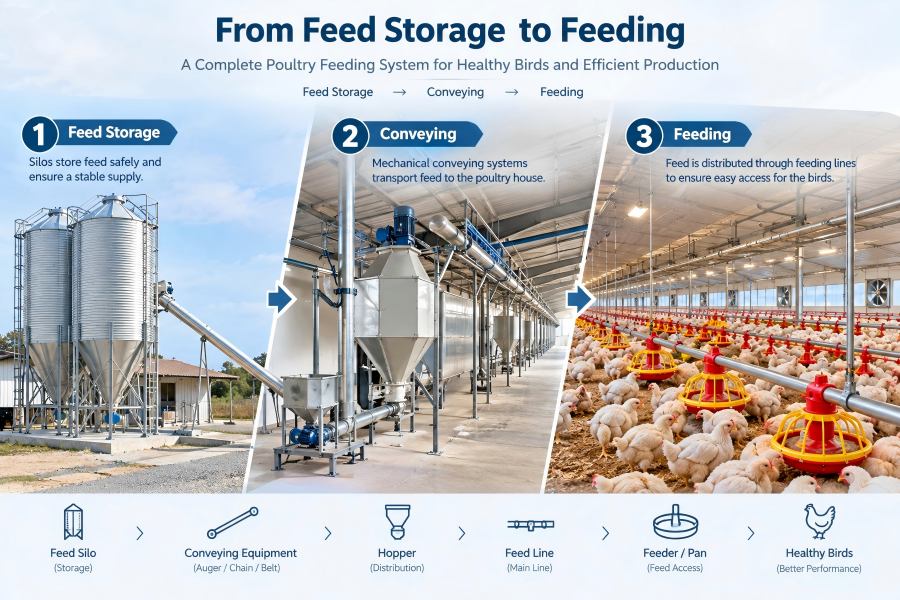
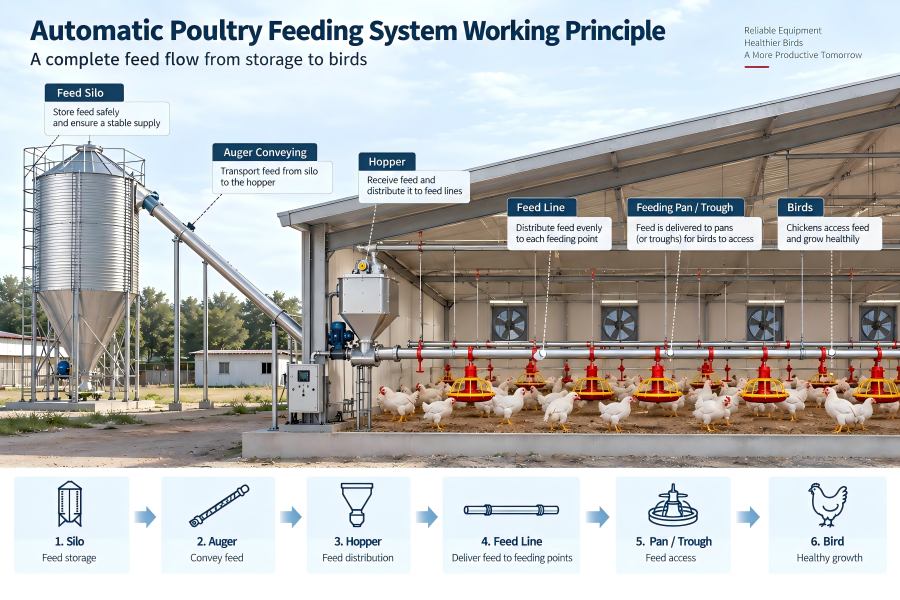
A typical automated feed-flow process is:
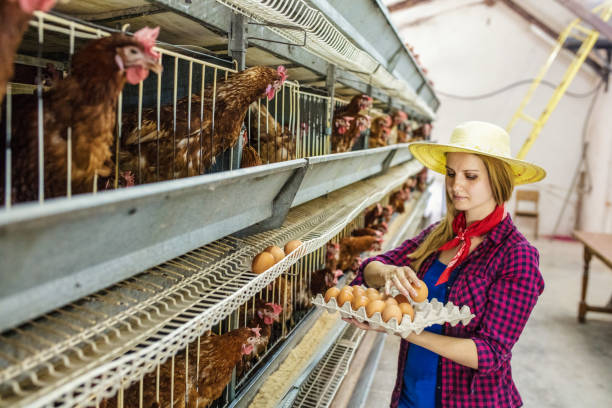
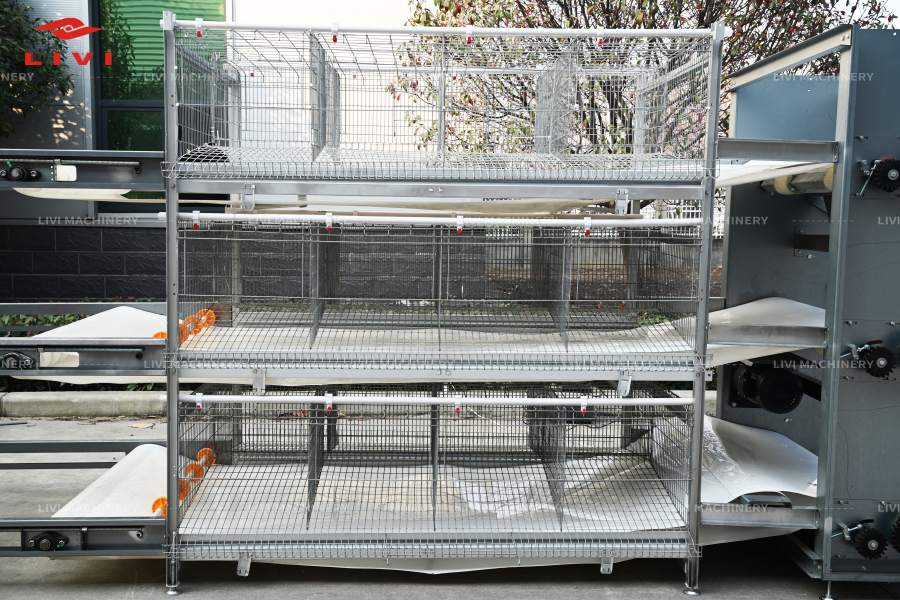
For layers, the feeding system must also work with the cage layout and daily egg-production workflow. For broilers raised on the floor, feed-line position, pan distribution and bird access across the house become important design considerations.
What Is a Poultry Feeding System?
A poultry feeding system is the equipment and management arrangement used to store, transport, distribute and present feed to chickens.
In a small flock, farmers may distribute feed manually. As flock size increases, commercial farms commonly introduce mechanical conveying and automated feeding equipment.
A complete system can include:
- feed silos;
- feed storage hoppers;
- main conveying equipment;
- auger or feed-line systems;
- feed troughs;
- feeding pans;
- drop pipes;
- drive motors;
- feed-level sensors;
- controllers and electrical components.
The actual equipment combination depends on the production system.
A commercial layer farm using cages does not necessarily require the same feeding arrangement as a broiler floor-rearing farm. A pullet house may also require a different feeder layout from a mature layer house.
This is why the first question should not be:
“How many feeders do I need?”
A better starting question is:
“How should feed move from storage to every bird in this poultry house?”
How to Choose the Right Poultry Feeding System?
Choosing feeding equipment should begin with the production system and poultry-house conditions.
1. Bird Type
The first consideration is whether the farm raises:
- layers;
- broilers;
- pullets;
- breeders.
Different bird types use different housing and feeding arrangements.
2. Flock Capacity
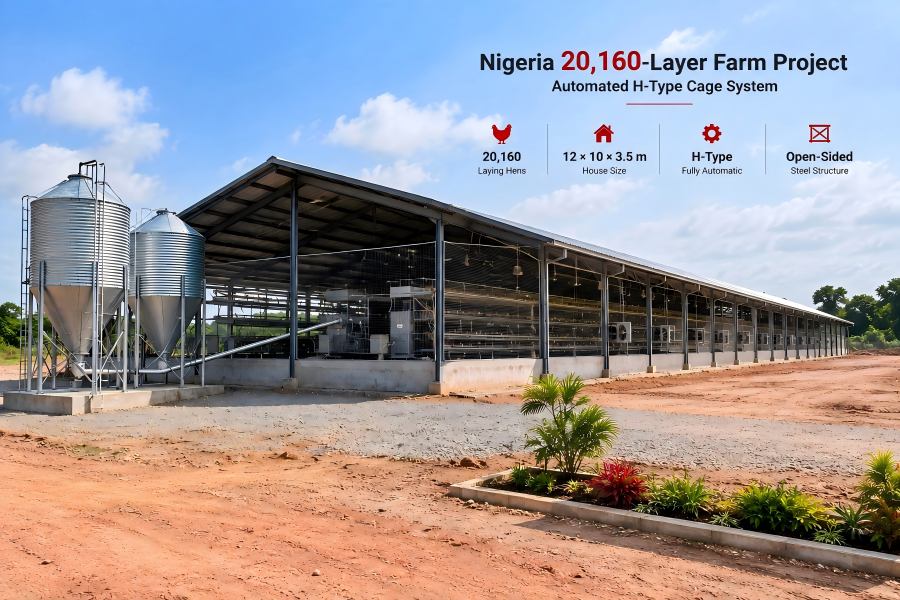
A feeding system for several hundred birds can be very different from a system designed for 20,000, 50,000 or more commercial birds.
As capacity increases, the designer must consider feed storage, conveying distance, number of feeding lines, feeder distribution, motor capacity and maintenance access.
3. Poultry House Dimensions
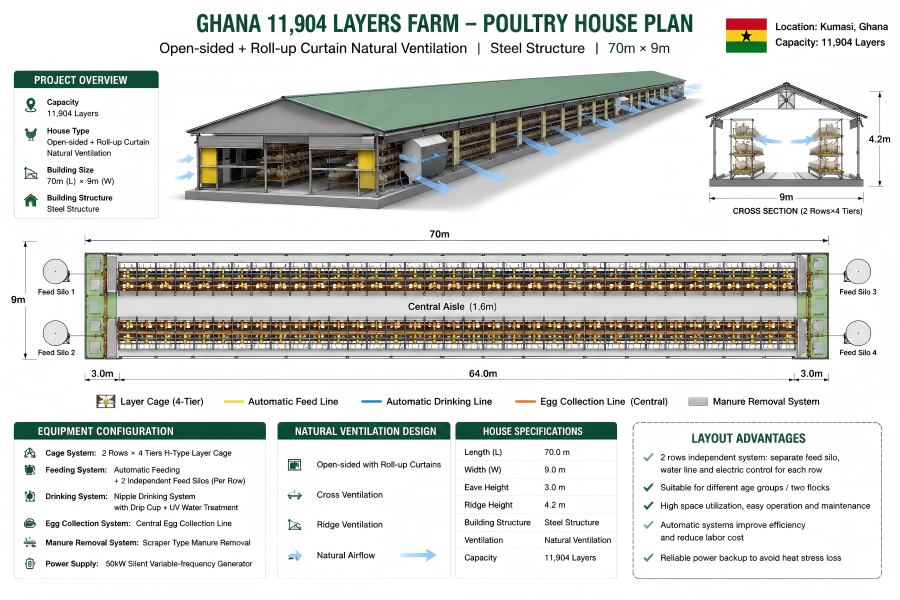
House length and width directly influence feeding-line arrangement.
A long poultry house may require several parallel feeding lines to provide practical bird access and consistent feed distribution.
The number of lines should therefore be calculated from the actual house layout rather than selected only from the flock size.
4. Feeding Method
The system should match the way birds are housed.
Broiler Floor Rearing → Pan Feeding System
Pullets → Age-Appropriate Feeding Arrangement
5. Automation Level
Commercial farms can use different automation levels:
- manual feeding;
- semi-automatic feeding;
- automatic feed conveying;
- automatic feeding with feed-level control;
- integrated farm automation.
6. Feed Storage and Conveying Distance
The location of the silo or feed storage area affects the conveying route.
Before selecting a motor, auger or feed line, the project should consider:
- horizontal conveying distance;
- vertical conveying requirements;
- number of houses;
- number of feeding lines;
- feed storage capacity;
- required feeding schedule.
7. Local Electrical Conditions
International poultry projects may operate under different voltage, frequency and phase conditions.
The feeding equipment specification should therefore be checked against the farm’s actual electrical supply before ordering.
7 Types of Poultry Feeding Systems
The following systems represent common approaches used in poultry production. They are not seven universally separate technologies; some systems can be combined within a complete commercial feeding arrangement.
1. Manual Poultry Feeding
Manual feeding is the simplest feeding method. Workers carry feed from storage and distribute it to feeders inside the poultry house.
Application
Manual feeding can be used for small flocks, temporary operations, young birds or farms where investment in automation is limited.
Advantages
- Simple equipment requirement
- Low initial equipment investment
- Easy to understand and operate
- Suitable for small-scale operations
Limitations
- Requires repeated manual work
- More difficult to maintain consistent distribution in large houses
- Feed handling becomes increasingly demanding as flock size increases
- Greater dependence on daily labor availability
2. Trough Feeding System
Trough feeding provides feed through elongated feeders rather than individual pans.
Depending on the farm design, troughs can be filled manually or connected to mechanical feed-delivery equipment.
Application
Trough systems can be used for different poultry groups, but feeder dimensions, placement and access must match bird age and housing conditions.
Advantages
- Simple feeding concept
- Easy visual inspection of feed
- Can be combined with different management systems
Limitations
- Manual filling can become labor-intensive
- Feed distribution depends strongly on feeder positioning
- Cleaning and feed-level management require regular attention
3. Chain Feeding System
A chain feeding system transports feed through a continuous feeder channel using a moving chain mechanism.
The chain circulates through the feeding route and distributes feed along the trough.
Application
Chain systems are commonly associated with layer and breeder housing where feed must be distributed along relatively long feeding routes.
Advantages
- Continuous feed distribution
- Suitable for long feeding routes
- Can be integrated into automated feeding schedules
Limitations
- Requires mechanical components and regular inspection
- Chain tension and alignment must be maintained
- Layout must be coordinated with the housing system
4. Auger Feeding System
An auger feeding system transports feed through a pipe using a rotating spiral conveyor.
Auger systems can be used to move feed from external storage toward indoor feeding equipment.
Application
They are widely relevant to automated commercial poultry houses where feed must travel from a silo or external storage point to indoor feeding equipment.
Advantages
- Enables mechanical feed conveying
- Can connect external storage with indoor feeding lines
- Suitable for automated farm layouts
- Can support multiple house configurations when properly designed
Limitations
- Requires appropriate motor and conveying design
- Long conveying routes require engineering verification
- Electrical and maintenance requirements must be considered
5. Pan Feeding System
Pan feeding systems deliver feed into individual feeding pans distributed along feed lines.
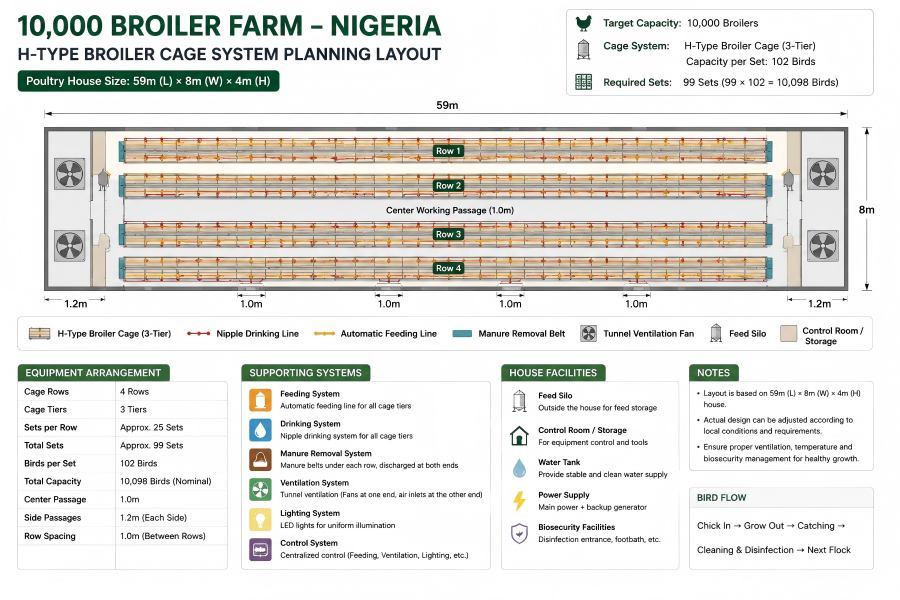
This method is particularly important in commercial broiler floor-rearing systems.
A typical process is:
LIVI’s commercial broiler pan feeding system uses 360 mm feeding pans with 14-grid or 16-grid configurations. The published system also includes feed-level adjustment and a feed-level sensor. :contentReference[oaicite:3]{index=3}
Advantages
- Suitable for commercial broiler floor rearing
- Feed can be distributed through multiple lines
- Feed level can be adjusted
- Can be connected to automatic feed conveying
Limitations
- Line arrangement must match house dimensions
- Pan quantity should not be selected independently from flock size and layout
- Feed-level adjustment requires appropriate management
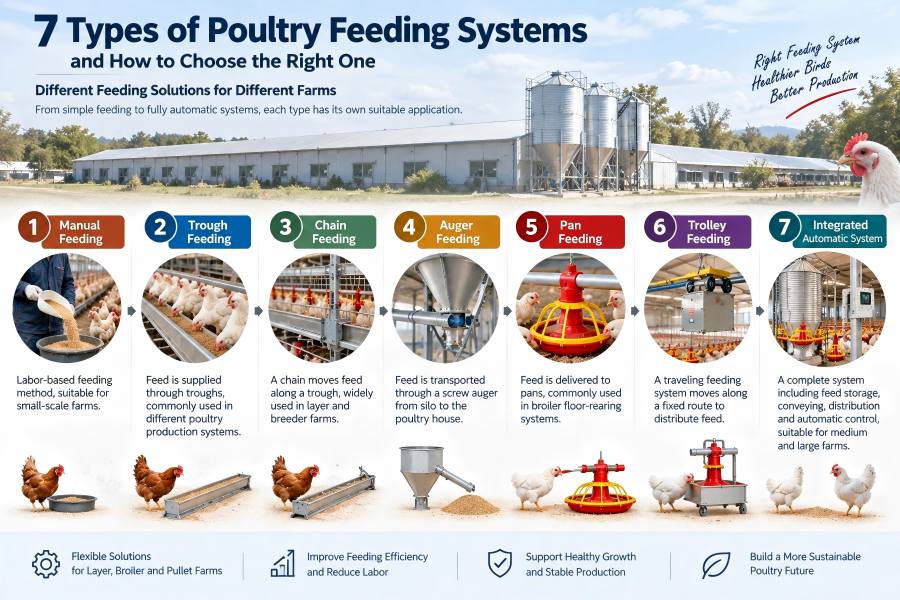
6. Trolley or Traveling Feeding System
A trolley or traveling feeding system moves along a predefined route to distribute feed to birds.
Instead of permanently placing a feeder at every position, the feeding equipment travels along the feeding route.
Application
Traveling systems can be considered for specific poultry-house layouts where mobile feed distribution is practical.
Advantages
- Flexible feed distribution
- Can cover long feeding areas
- Suitable for selected housing configurations
Limitations
- Requires sufficient travel clearance
- Building layout must accommodate the equipment
- Movement and maintenance components require regular inspection
7. Integrated Automatic Poultry Feeding System
An integrated automatic poultry feeding system combines storage, conveying, distribution, feed-level control and feeding equipment into one coordinated production flow.
This is the type of system commonly considered for medium and large commercial farms where repetitive feed handling needs to be mechanized.
The actual configuration can vary significantly between a layer cage house and a broiler floor-rearing house.
Advantages
- Automated feed transportation
- Reduced routine manual feed handling
- Suitable for larger commercial farms
- Can integrate feed-level monitoring
- Can be designed around the complete poultry-house layout
Limitations
- Higher equipment investment than manual systems
- Requires electrical power
- Requires installation and maintenance
- Incorrect layout can affect system performance
- Backup planning may be required where power reliability is limited
How Does an Automatic Poultry Feeding System Work?
The operating principle of an automatic poultry feeding system is relatively straightforward: feed is stored outside the house, transported mechanically and distributed to feeders inside the poultry house.
Step 1: Feed Storage
Feed is stored in a silo, hopper or other suitable storage unit.
Step 2: Feed Conveying
A conveying system transfers feed from storage toward the poultry house.
Depending on the project, this can involve augers, feed lines, hoppers or other mechanical conveying equipment.
Step 3: Feed Distribution
Feed enters the indoor distribution system and moves along the feeding route.
Step 4: Feeder Filling
Feed is delivered to troughs, pans or other feeding points.
Step 5: Feed-Level Control
Sensors or mechanical controls can be used to maintain feed availability according to the system design.
Step 6: Bird Access
Birds access the feed according to the housing system and feeder arrangement.
Layer Feeding Systems vs. Broiler Feeding Systems
One of the most important distinctions in poultry equipment selection is whether the farm produces eggs or broiler meat.
| Factor | Layer Farm | Broiler Farm |
|---|---|---|
| Production Objective | Egg production | Meat production |
| Typical Housing | Cage / cage-free / aviary | Floor rearing / selected cage systems |
| Feeding Equipment | Trough, chain, trolley or integrated systems | Pan feeding is widely used in floor systems |
| Feed Distribution | Along cage rows or housing areas | Across floor-rearing feeding lines |
| Layout Priority | Cage rows + operating aisles + feeding access | Feed-line distribution + bird access + house airflow |
| Automation | Often integrated with cage automation | Often integrated with pan feeding and environmental systems |
For example, LIVI’s published commercial layer projects integrate feeding with cage configuration and other production systems, while its broiler floor-rearing solutions use automatic pan feeding together with nipple drinking and environmental equipment. :contentReference[oaicite:5]{index=5}
How Many Feeding Lines Does a Poultry Farm Need?
There is no universal number of feeding lines for every poultry house.
The required number depends on:
- bird capacity;
- house width;
- house length;
- bird age;
- feeder type;
- feeder spacing;
- housing system;
- access requirements;
- equipment dimensions;
- local management practices.
For example, a 15,000-broiler project and a 50,000-broiler project cannot automatically use the same number of feeding lines simply because both use pan feeders.
The line quantity must be checked against the actual house geometry.
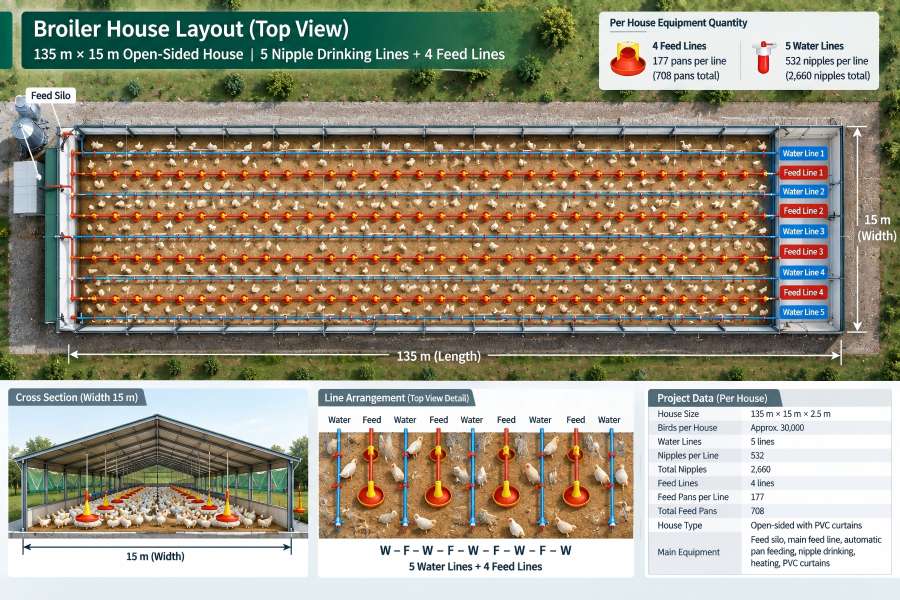
In a recent LIVI project for 60,000 broilers in Zimbabwe, for example, the planning configuration uses two 135 × 15 m open-sided houses, with four automatic feeding lines and five nipple drinking lines per house. The line arrangement was developed around the individual house rather than using one generic line count.
This illustrates an important procurement principle: line quantity is a design result, not a standalone product specification.
Common Mistakes When Choosing Poultry Feeding Equipment
Mistake 1: Choosing Only by Equipment Price
A lower equipment quotation does not necessarily represent a lower total project cost.
The buyer should compare the complete scope, including feed storage, conveying, feeding points, motors, controls, installation and spare parts.
Mistake 2: Choosing the Feeder Before Designing the House
Feeder dimensions and line positions affect the usable space inside the poultry house.
Equipment should therefore be checked against the house drawing before final ordering.
Mistake 3: Selecting the Number of Feeders Only by Bird Capacity
Bird capacity is important, but it is not the only variable.
House width, line length, feeder spacing and bird access also affect the final configuration.
Mistake 4: Ignoring Electrical Conditions
International projects should verify:
A system should be compatible with the actual farm power supply.
Mistake 5: Ignoring Feed Storage Capacity
A feeding line cannot solve an inadequate feed-storage strategy.
For larger farms, silo capacity, delivery frequency and conveying distance should be considered together.
Mistake 6: Ignoring Maintenance Access
Automatic equipment still requires inspection, cleaning, adjustment and replacement of wearing components.
The final layout should leave practical access for maintenance.
Mistake 7: Treating “Automatic” as a Complete Specification
The word “automatic” alone does not tell a buyer enough.
A quotation should identify:
- feeder type;
- line length;
- motor specification;
- feed conveying method;
- hopper arrangement;
- sensor configuration;
- control method;
- electrical requirements;
- installation scope.
How to Select the Right Feeding System for Your Farm
A practical selection process can be simplified into seven steps.
↓
Step 2: Define Flock Capacity
↓
Step 3: Confirm Poultry-House Dimensions
↓
Step 4: Select Housing / Rearing Method
↓
Step 5: Determine Feeding Method
↓
Step 6: Design Feed Storage + Conveying + Distribution
↓
Step 7: Verify Power, Maintenance and Expansion
Example: Commercial Layer Farm
A layer project should first define the cage or cage-free system.
The feeding system can then be integrated with the housing arrangement:
Example: Commercial Broiler Farm
For a floor-rearing broiler project, the sequence is different:
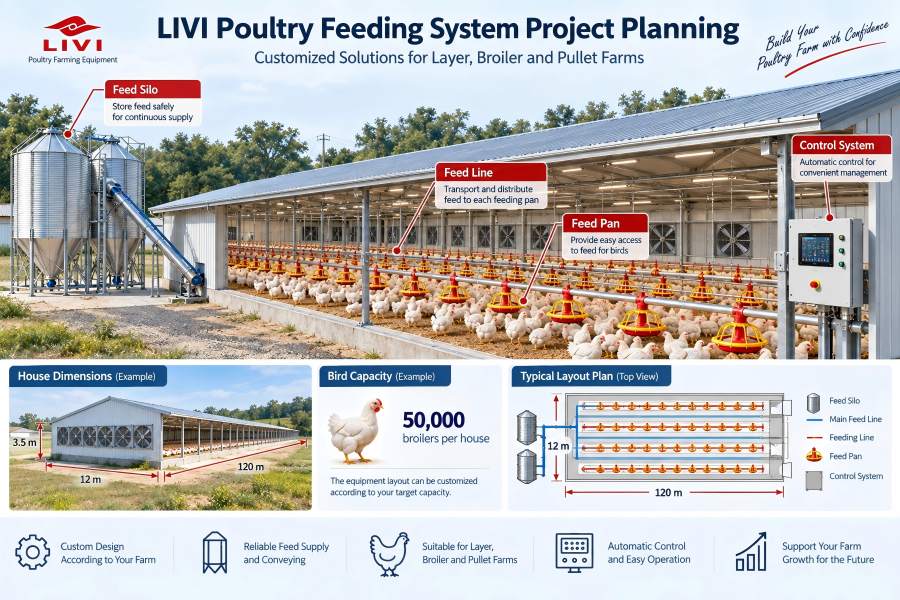
This project-level approach is consistent with LIVI’s published commercial farm solutions, where equipment selection is developed around bird capacity, poultry-house dimensions and the required production workflow rather than treating individual machines as isolated purchases. :contentReference[oaicite:7]{index=7}
What Information Should You Send to a Poultry Equipment Supplier?
Before requesting a quotation, prepare the following information:
| Project Input | Information to Provide |
|---|---|
| Country | Farm location and market |
| Bird Type | Layer, broiler, pullet or breeder |
| Capacity | Total target birds |
| House | Length × width × height |
| Housing | A-Type, H-Type, floor, cage-free, etc. |
| Feeding | Manual, semi-automatic or automatic |
| Water | Water source and drinking system |
| Power | Voltage, frequency and phase |
| Climate | Temperature and ventilation conditions |
| Expansion | Future farm capacity |
For a complete design, a poultry-house drawing is even more useful.
LIVI’s published feeding-system information similarly asks buyers to provide flock capacity, house dimensions, number of houses and local power specifications when preparing a feeding-system configuration. :contentReference[oaicite:8]{index=8}
Frequently Asked Questions About Poultry Feeding Systems
1. What are the main types of poultry feeding systems?
Common systems include manual feeding, trough feeding, chain feeding, auger conveying, pan feeding, trolley or traveling feeding, and integrated automatic feeding systems. Different systems can also be combined within one commercial farm.
2. Which feeding system is suitable for broiler floor rearing?
Automatic pan feeding is widely used for commercial broiler floor-rearing systems. The final configuration depends on flock capacity, house dimensions, feeder specifications, line quantity and local electrical conditions.
3. Which feeding system is suitable for layer cages?
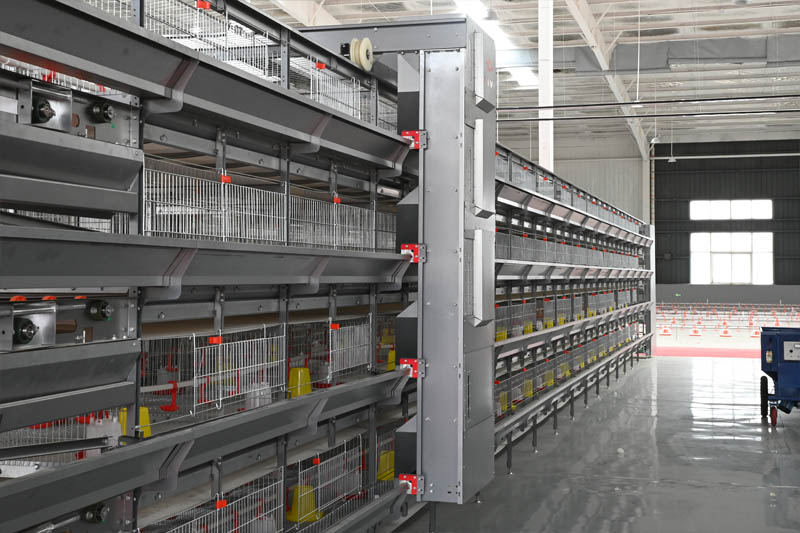
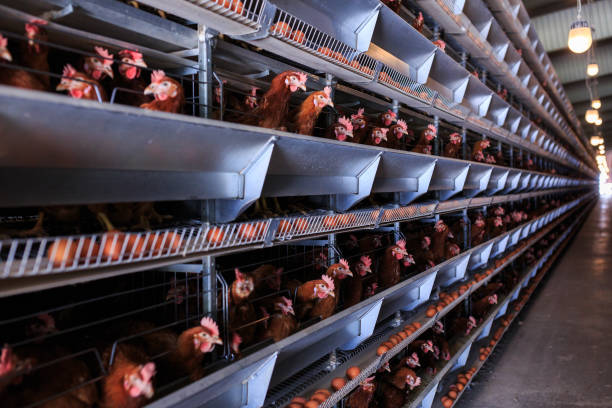
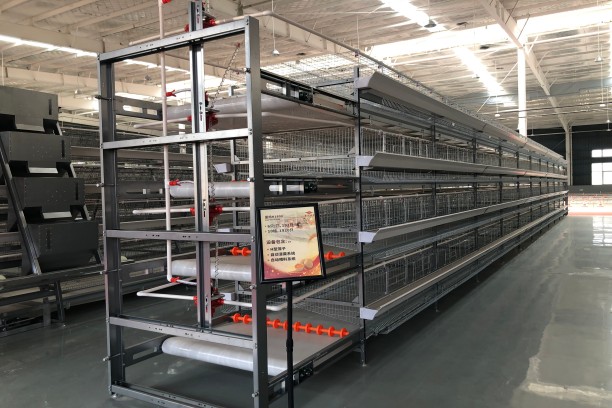
Layer cage farms can use feeding arrangements such as trough, chain, trolley or other integrated cage-feeding systems depending on cage design and automation level. The feeding equipment should be selected together with the cage-row layout.
4. How many feeding lines does a broiler house need?
There is no universal number. The final quantity depends on bird capacity, house width and length, feeder type, feeder spacing, bird age and the overall floor layout.
5. What is the difference between an auger and a feeding pan?
An auger is primarily a feed-conveying component that moves feed through a pipe or conveying route. A feeding pan is the point where birds access the feed. In an automatic broiler system, both can work together.
6. Is automatic feeding necessary for a commercial poultry farm?
Not every farm requires the same level of automation. The decision depends on flock size, labor availability, farm management practices, investment budget and the desired production workflow.
7. What information is needed to design an automatic poultry feeding system?
At minimum, provide bird type, flock capacity, number of houses, house length and width, feeding method, preferred automation level and local electrical specifications. A house drawing can further improve the design.
Final Takeaway: Select the Feeding System as Part of the Farm
The right poultry feeding system is not determined by one component, one motor or one feeder price.
The purpose of a commercial feeding system is to create a practical and controllable feed-delivery route from storage to the birds.
For buyers comparing poultry feeding equipment, the most useful next step is to prepare the actual farm parameters before requesting a quotation.
Provide your country, bird type, target capacity, poultry-house dimensions and required automation level. LIVI Machinery can then evaluate the appropriate feeding configuration together with the rest of the poultry-house equipment.
Need a Poultry Feeding System for Your Farm?
Send your farm capacity and poultry-house dimensions to discuss a project-specific feeding-system configuration.
Request a Poultry Farm Equipment Proposal