



For a commercial broiler farm in Zimbabwe, the initial equipment price is only one part of the investment. House construction, feed distribution, water reliability, brooding conditions and electricity supply can significantly affect both startup costs and daily operating expenses.
This project illustrates how LIVI Machinery approaches equipment planning for a 60,000-bird floor-rearing operation where reliable grid power is unavailable.
Project status: The following figures describe a proposed equipment configuration. Final installation, contract value and production performance have not been verified.
Zimbabwe 60,000-Broiler Project Overview
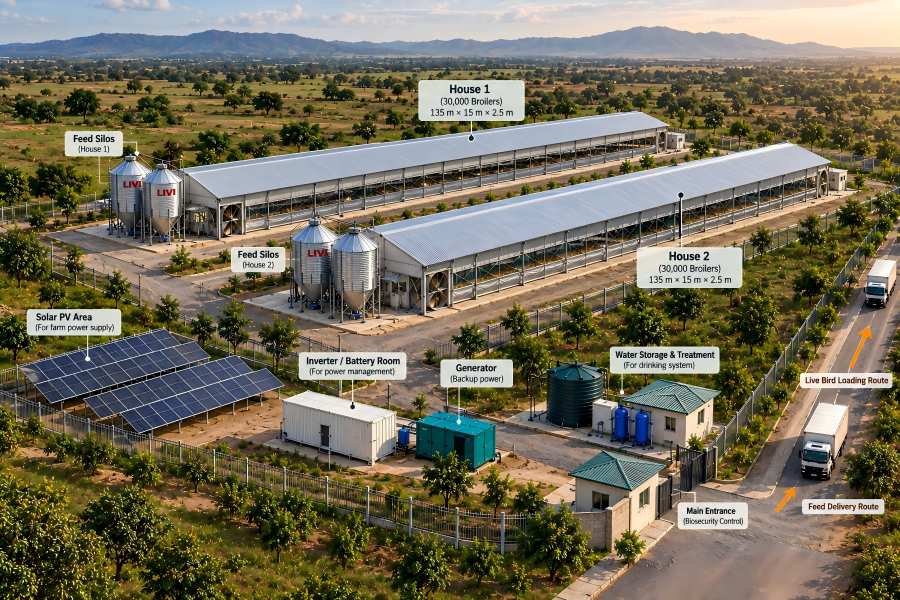
The customer plans to raise approximately 60,000 broilers in two open-sided poultry houses. Each building provides 2,025 m² of gross floor area.
| Project Item | Planned Specification |
|---|---|
| Location | Zimbabwe |
| Farming Type | Broiler floor rearing |
| Total Capacity | 60,000 broilers |
| Number of Houses | 2 open-sided poultry houses |
| Capacity per House | Approximately 30,000 birds |
| House Dimensions | 135 × 15 × 2.5 m |
| Gross Area per House | 2,025 m² |
| Indicative Stocking Density | 14.81 birds/m² of gross area |
| Feeding Equipment | Feed silo, main auger and automatic pan feeding |
| Drinking Equipment | Automatic nipple drinking lines |
| Environment | Heating and adjustable PVC curtains |
| Power Supply | No grid connection; off-grid system required |
The preliminary density is calculated from gross building area. Final bird placement must consider usable floor space, market weight, seasonal temperature, ventilation capacity and applicable welfare requirements.
What Equipment Is Needed for Each 30,000-Broiler House?
The proposed floor-rearing equipment combines automatic feed distribution with controlled drinking water and adjustable environmental conditions.
| Equipment | Per House | Two Houses |
|---|---|---|
| Feeding Lines | 4 | 8 |
| Feed Pans per Line | 177 | 177 per line |
| Total Feed Pans | 708 | 1,416 |
| Birds per Feed Pan | Approximately 42.4 | Same ratio |
| Drinking Lines | 5 | 10 |
| Nipples per Line | 532 | 532 per line |
| Total Nipples | 2,660 | 5,320 |
| Birds per Nipple | Approximately 11.3 | Same ratio |
Automatic Pan Feeding
Feed is planned to move from an external silo through a main conveying line into the house feeding system. Four pan-feeding lines distribute feed across each 135 m building.
The preliminary allocation is approximately 42.4 broilers per feed pan. Before manufacturing, the selected pan model must be checked for its rated capacity, bird access, line length and feed-conveying performance.
See the LIVI automatic broiler pan feeding system for equipment components and purchasing considerations.
Nipple Drinking
Five drinking lines with 532 nipples each provide 2,660 drinking points per house, or approximately 11.3 birds per nipple.
The Ross Broiler Pocket Guide 2025 provides reference nipple requirements that vary with bird weight. For broilers above 3 kg, the proposed number may require an increase.
The design must also verify water flow, line pressure, filtration, water storage and backup pumping arrangements.
For additional specifications, review the automatic poultry drinking system.
Check Your Broiler Equipment Configuration
Share your house dimensions, flock size and target market weight for a feeding and drinking layout review.
How Much Does a 60,000-Broiler Farm Cost in Zimbabwe?
The total cost of a 60,000-broiler farm in Zimbabwe cannot be determined from the number of chickens alone. For this project, the investor must budget for two poultry houses, automated feeding and drinking equipment, heating, water infrastructure, independent electricity and production-cycle expenses.
Because the site has no grid electricity, the power system is a major additional investment compared with a farm that already has a reliable electrical connection.
| Cost Category | Main Budget Items | Cost-Control Consideration |
|---|---|---|
| House Construction | Two 135 × 15 m houses, foundations, roofing, floor and structural materials | Obtain local construction quotations and verify the building design |
| Automatic Feeding | Feed silos, main augers, eight feeding lines and proposed feed pans | Confirm the final number of pans, motors and conveying capacity |
| Automatic Drinking | Ten nipple lines, water regulators, pipes and supporting equipment | Check water flow, storage and backup supply |
| Heating & Curtains | Brooding heaters, temperature controls and PVC curtains | Compare fuel options and verify minimum ventilation |
| Off-Grid Power | Solar PV, battery storage, inverter, generator and electrical protection | Size equipment from measured or calculated loads |
| Shipping & Installation | Freight, applicable import charges, inland transport and installation | Confirm quotation inclusions and delivery terms |
| Working Capital | Day-old chicks, feed, litter, labor, veterinary care, fuel and maintenance | Budget for the full production cycle and contingency |
How Should Investors Calculate Cost per Bird?
Installed equipment cost per bird = total installed equipment investment ÷ 60,000.
Production cost per bird placed = total operating expenditure for one cycle ÷ chicks placed.
These figures answer different questions. The first evaluates equipment investment; the second evaluates the cost of raising a flock. For profitability, the farm must also track feed conversion, mortality, final live weight and selling price.
No verified contract price or construction budget is available for this project. An accurate quotation requires final equipment specifications, local construction costs, electrical loads and delivery arrangements.
Broiler Floor Rearing vs. Cage Farming: Which Is More Cost-Effective?
| Comparison | Floor Rearing | Broiler Cage Farming |
|---|---|---|
| Bird Housing | Litter-covered floor | Multi-tier cages |
| Equipment Investment | Pan feeding, nipple drinking and environmental equipment | Cages plus integrated feeding, drinking and manure systems |
| Manure Management | Litter management and removal between flocks | Depends on the selected manure-removal system |
| Space Utilization | Uses available floor area | Can utilize vertical space |
| Cost Evaluation | Housing, litter, labor, equipment and utilities | Cages, building requirements, automation and maintenance |
Floor rearing may require less initial housing equipment than a highly automated cage system, but neither method is automatically cheaper over the full production lifecycle.
For another example of equipment-budget planning, see the broiler floor rearing cost analysis. Country-specific construction and operating costs should not be transferred directly to Zimbabwe.
How Can This Broiler Farm Operate Without Grid Electricity?
The absence of a grid connection changes the farm’s electrical design. Water supply, essential ventilation, temperature monitoring and equipment controls must remain dependable during both daytime and nighttime operation.
Zimbabwe’s National Renewable Energy Policy supports off-grid renewable-energy technologies in locations where conventional grid extension is not economically practical.
For this project, the recommended starting point is a solar PV + battery storage + automatically started diesel generator arrangement.
Recommended Power System
| Power Component | Recommended Function |
|---|---|
| Solar PV | Supply part of the daytime electricity demand and reduce generator operating hours |
| Battery Storage | Support designated critical loads during source switching and selected nighttime periods |
| Diesel Generator | Provide dispatchable electricity during extended low-solar periods or high electrical demand |
| Hybrid Inverter & Controls | Coordinate power sources and manage charging and essential loads |
| Electrical Protection | Provide grounding, circuit protection, safe switching and fault isolation |
Why Not Use Solar Power Alone?
Solar panels generate electricity according to available sunlight. They cannot independently guarantee power during nighttime, prolonged cloud cover or equipment faults.
For a commercial poultry farm, battery storage can support selected essential equipment, while a generator provides additional resilience. The system should include alarms and a documented response procedure for power failures.
Should the Brooding Heaters Be Electric?
Not necessarily. Electric heating can create a substantial power demand during brooding, particularly when outside temperatures are low.
The investor should compare electric heating with appropriately designed fuel-fired alternatives, such as LPG heating, based on local fuel availability, safety, operating cost and environmental-control requirements.
Fuel-fired heating still requires adequate ventilation, combustion safety and reliable electrical power for any associated controls.
How Should the Solar and Generator Capacity Be Calculated?
Before selecting generator kVA, solar kWp or battery kWh, the electrical contractor should prepare a complete load schedule covering:
- Feeding-line motors and main feed augers
- Water pumps and pressure-control equipment
- Essential ventilation equipment, if required
- Heating controls and auxiliary motors
- Lighting, monitoring and alarm systems
- Motor starting currents and simultaneous operation
- Nighttime demand and required emergency backup duration
Illustrative calculation: A critical load of 5 kW operating for four hours requires 20 kWh of usable electrical energy before allowing for conversion losses and design reserves. This is a calculation example, not the measured load of this farm.
The generator must also be assessed for motor-starting capability, site conditions and reserve capacity. Where economically justified, independent backup generation or an alternative emergency arrangement should be considered to avoid reliance on a single generator.
Zimbabwe Energy Regulations
The Zimbabwe Energy Regulatory Authority (ZERA) publishes electricity regulations and documentation for generation facilities, including 2026 provisions concerning generation for own consumption.
The farm owner should consult a qualified Zimbabwe-based electrical contractor to confirm applicable registration, licensing, installation and inspection requirements before purchasing the system.
Need an Equipment and Off-Grid Cost Plan?
Request a project-based equipment quotation and the electrical load information needed for local power-system engineering.
How Can the Investor Reduce Equipment and Operating Costs?
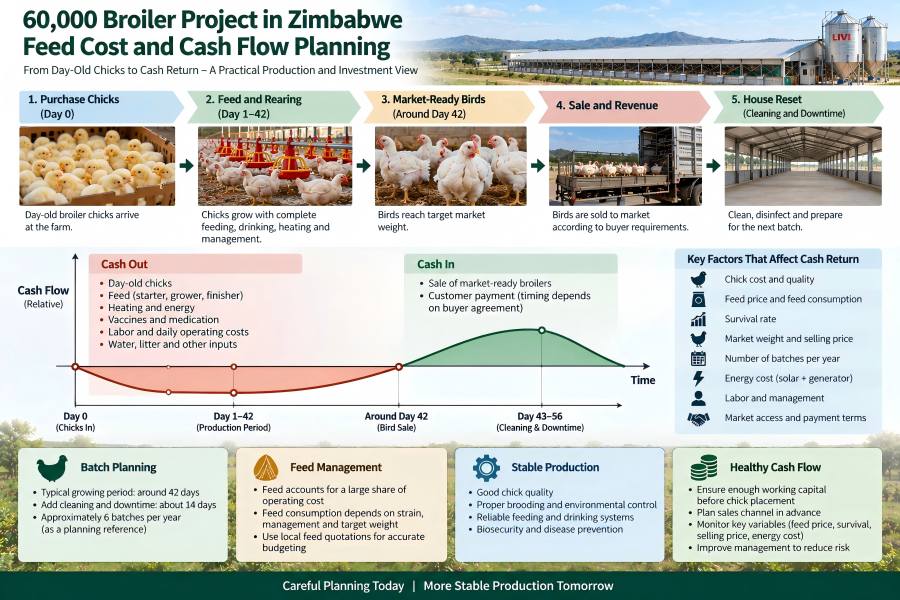
For this 60,000-broiler project, cost reduction should focus on avoiding unnecessary equipment, preventing supply interruptions and controlling recurring expenses rather than choosing the lowest-priced components.
Five Practical Cost-Control Priorities
- Finalize the house layout first. Confirm feeder and drinker quantities, line positions, service access and equipment clearances before manufacturing.
- Verify water and feed capacity. Check the planned 708 pans and 2,660 nipples per house against the selected equipment and target market weight.
- Separate electrical and heating loads. Compare suitable heating fuels before increasing the size of the solar, battery and generator system.
- Compare complete landed costs. Include freight, applicable import charges, local transportation, installation and commissioning.
- Protect the operating budget. Allow for generator fuel, solar-system maintenance, feed costs, litter replacement and emergency repairs.
For commercial poultry farm investors, the most useful supplier quotation is one that identifies both included equipment and items requiring separate local procurement.
What Should the Poultry Equipment Supplier Include in the Quotation?
Before purchasing from a poultry equipment manufacturer or factory, the investor should request a complete bill of materials and clear delivery responsibilities.
| Quotation Item | Required Confirmation |
|---|---|
| House Layout | Approved drawings for both 135 m houses |
| Feeding Equipment | Silo, main auger, motors, pans, sensors and line quantities |
| Drinking Equipment | Nipples, regulators, pipes, filters and water-storage interfaces |
| Environmental Equipment | Heating, curtains and any required ventilation equipment |
| Electrical Requirements | Motor ratings, starting requirements and essential-load schedule |
| Delivery Terms | Incoterm, freight, import responsibilities and destination |
| After-Sales | Installation guidance, warranty, spare parts and technical support |
LIVI Machinery can use the final house layout and selected equipment configuration to prepare a project-specific supply proposal. The solar and generator system should be engineered and checked against local requirements by a qualified electrical specialist.
Project Takeaways for Commercial Broiler Investors in Zimbabwe
This project illustrates how a 60,000-bird floor-rearing operation can be planned around two large open-sided houses, automatic feeding and drinking, and an independent electricity supply.
Three decisions remain essential before procurement: confirming equipment coverage against the target bird weight, verifying ventilation and heating requirements, and completing the off-grid electrical load calculation.
The project has not yet provided verified installation or production results. Accordingly, no claims are made about actual electricity savings, feed conversion, mortality, profit or investment payback.
For farm owners, integrators and EPC contractors, the value of this case lies in its practical planning framework: coordinate housing, poultry equipment, water and power before committing to the full project investment.
Frequently Asked Questions About Broiler Farm Costs in Zimbabwe
1. How much does a 60,000-broiler farm cost in Zimbabwe?
The total depends on house construction, feeding and drinking equipment, heating, ventilation, off-grid power, shipping, installation and working capital. This project’s contract value has not been disclosed, so an exact price cannot be verified. A detailed quotation should be prepared from the approved layout and equipment specifications.
2. What equipment is required for a 30,000-broiler floor-rearing house?
The proposed configuration includes a feed silo and main conveying line, four automatic pan-feeding lines, five nipple-drinking lines, heating and PVC curtains. Water storage, environmental controls, ventilation and electrical equipment must also be evaluated according to site conditions.
3. Are 708 feed pans enough for 30,000 broilers?
708 pans provide approximately 42.4 birds per pan. Whether this is sufficient depends on the selected pan model, its rated capacity, the target market weight and the feeding-line layout. The quantity requires technical confirmation before procurement.
4. How many nipple drinkers are needed for 30,000 broilers?
The proposed system provides 2,660 nipples, or approximately 11.3 birds per nipple. Aviagen’s reference requirements vary with final bird weight, so the number must be checked against the production target and the selected drinker specification.
5. Can solar power operate an automatic broiler farm in Zimbabwe?
Solar PV can supply part of the farm’s electrical demand, but reliable nighttime and emergency operation requires additional planning. For this off-grid project, a solar-battery-generator hybrid is recommended for engineering evaluation. Final capacity depends on the electrical load schedule.
6. Is a diesel generator necessary if the poultry farm has solar panels?
A generator is a practical source of dispatchable backup power for a farm without grid access. Its necessity and capacity should be assessed against battery autonomy, critical loads, weather variability and the farm’s acceptable level of operational risk.
7. What information is needed for a complete broiler farm equipment quotation?
Provide the country, target capacity, number and dimensions of houses, target market weight, preferred feeding and drinking systems, heating requirements, water availability, electricity conditions and delivery destination. An approved layout and electrical load schedule improve quotation accuracy.
Planning a Commercial Broiler Farm in Zimbabwe?
Share your project capacity, poultry-house dimensions and power conditions to request a tailored equipment configuration and quotation.