



When planning a commercial layer farm, investors often ask a simple question:
The question sounds like a comparison of equipment prices. In practice, it is a comparison of two different investment structures.
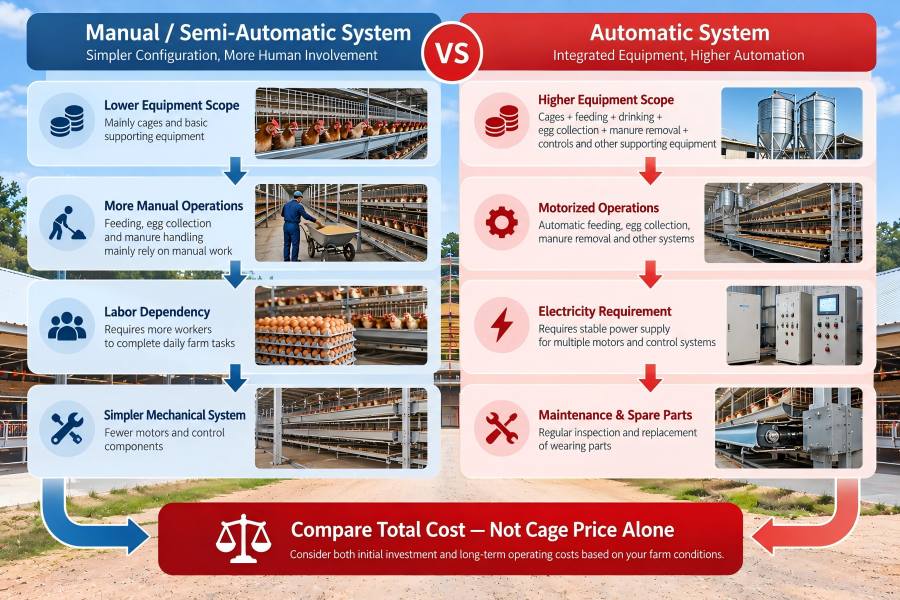
A lower initial equipment quotation does not automatically mean a lower total farm cost. Likewise, a highly automated system is not automatically the most economical choice for every farm.
The correct comparison needs to separate:
This guide uses that framework to compare manual, semi-automatic and automatic poultry equipment for commercial layer farms.
Manual vs Automatic Poultry Farm Equipment: What Is Actually Different?
Before comparing cost, buyers need to define what “manual” and “automatic” actually include.
In commercial layer production, automation is rarely a simple yes-or-no choice. Different functions can be automated independently.
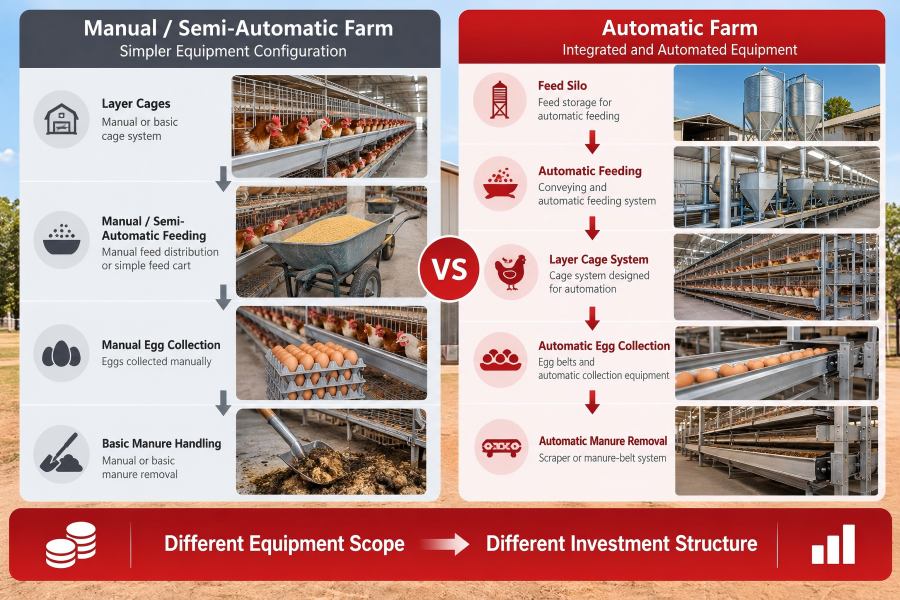
| Farm Function | Manual / Basic System | Automatic System |
|---|---|---|
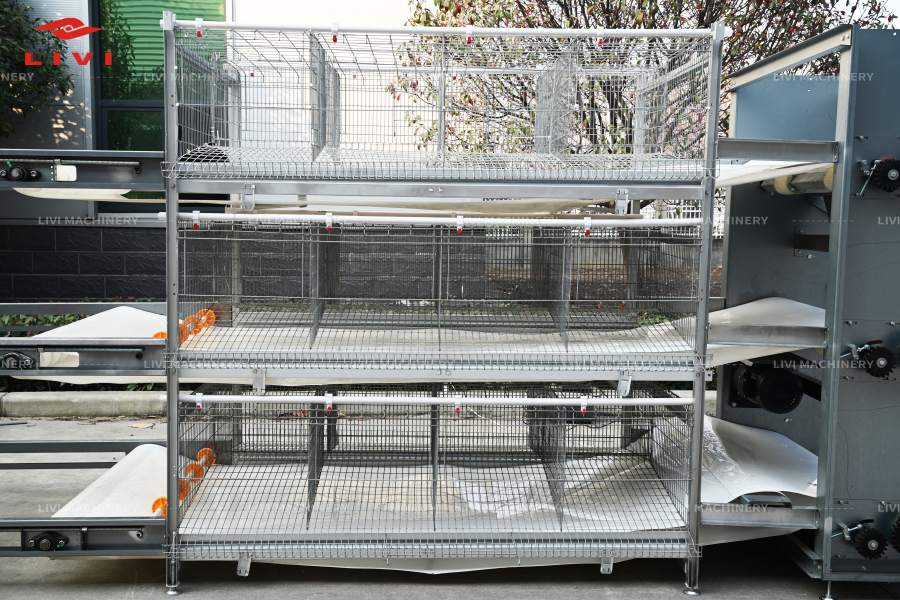
| Layer Housing | Layer cages with basic accessories | Cage system designed around automated equipment interfaces |
| Feeding | Manual feed distribution or simple feed cart | Feed silo, conveying and automatic feeding equipment |
| Drinking | Basic drinking equipment | Nipple drinking line integrated with water supply and regulation |
| Egg Collection | Eggs collected manually | Egg belts and automatic collection equipment |
| Manure Removal | Manual or basic manure handling | Scraper or manure-belt equipment according to cage design |
| Environment | Natural ventilation or manually operated equipment | Fans, cooling and environmental-control equipment where required |
| Control | Individual manual operation | Electrical controls coordinating multiple systems |
This distinction matters when comparing quotations. Two suppliers may both quote a “10,000-layer farm,” while one quotation covers mainly cages and the other includes several automatic systems.
Therefore, comparing only the final quotation value can produce the wrong conclusion.
Initial Investment: Why Manual Poultry Equipment Usually Starts Lower
The most visible difference is the initial equipment investment.
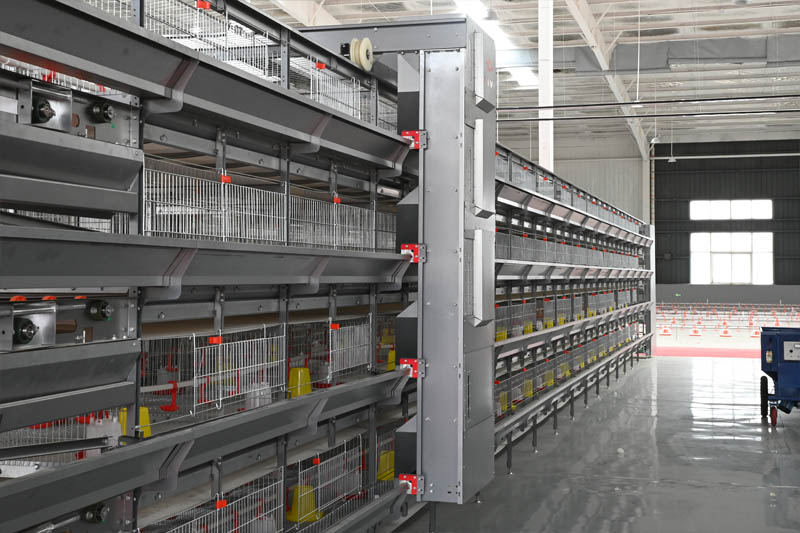
A basic commercial layer farm may begin with cages, drinking equipment and relatively simple feeding, egg collection and manure-handling methods. An automated project adds motors, conveying equipment, feed storage, electrical controls and other supporting components.
That normally creates a larger equipment scope before the farm begins operation.
What Creates the Initial Cost Difference?
| Cost Category | Why It Changes |
|---|---|
| Chicken Cages | Cage type, configuration, tiers, capacity and quantity |
| Feeding | Manual feeding requires less equipment; automatic feeding adds conveying and distribution equipment |
| Feed Storage | Automatic projects may include feed silos and conveying interfaces |
| Egg Collection | Automatic systems add belts, drives and collection interfaces |
| Manure Removal | Equipment configuration depends on cage type and manure-handling method |
| Electrical System | Motors and automatic controls increase electrical requirements |
| Installation | More integrated equipment generally creates more installation interfaces |
This is why searching only for the cheapest layer cage price provides an incomplete picture of a commercial farm investment.
The buyer first needs to define the equipment boundary.
Quotation B: Cages + Feeding + Drinking + Egg Collection + Manure Removal + Feed Storage + Controls
These are fundamentally different supply scopes and should not be compared as if they were equivalent.
Operating Cost: The Part Buyers Often Miss
Initial investment is only one side of the cost equation.
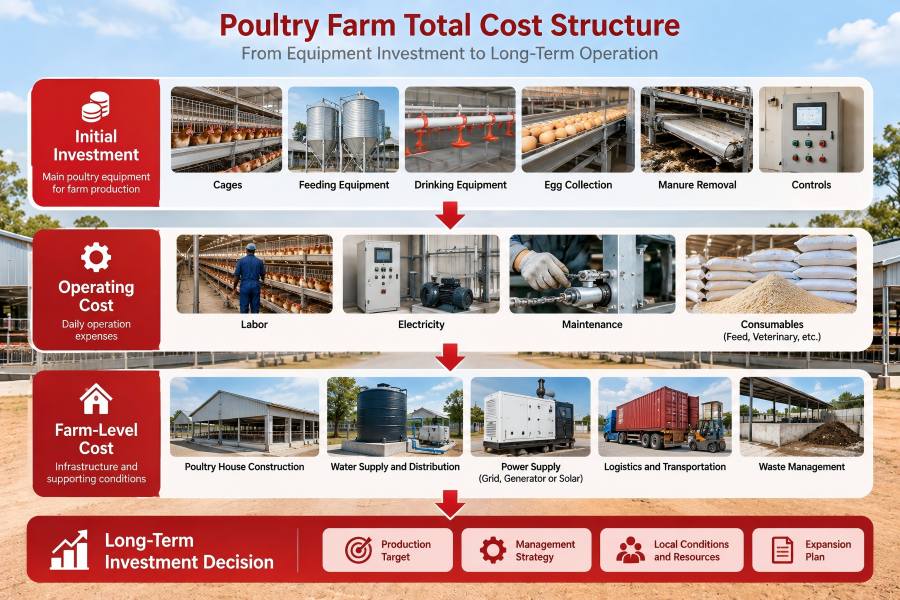
Once the farm starts operating, the cost structure shifts toward labor, electricity, maintenance, feed handling, manure management and equipment servicing.
Initial Investment + Recurring Operating Costs + Maintenance + Replacement + Management Requirements
This is where the economics of a manual and an automatic farm begin to differ more clearly.
Manual Farm Operating Cost
A farm with less automation may require more routine human involvement in tasks such as distributing feed, collecting eggs and handling manure.
Whether this is economically attractive depends heavily on local labor availability, wages, farm scale and management conditions.
Automatic Farm Operating Cost
An automated farm transfers more routine operations to mechanical and electrical systems. However, automation introduces its own operating requirements, including electricity, preventive maintenance, replacement parts and trained operators.
For that reason, the right question is not:
A better question is:
Labor Cost: When Does Automation Become More Relevant?
Labor is one of the most important variables when comparing poultry farm automation.
A small layer farm may be able to operate several tasks manually without creating an unmanageable workload. As flock capacity increases, however, the volume of repetitive work also increases.
Examples include:
- moving and distributing feed;
- collecting eggs from cage rows;
- removing manure;
- checking equipment and water supply;
- moving materials through the poultry house.
FAO notes that as poultry production develops from smaller commercial operations toward medium- and large-scale production, the use of commercial materials, equipment, mechanization and automation generally increases.
This does not establish a universal flock-size threshold for automation. It does show why farm scale and management complexity need to be considered together.
A 5,000-layer project in a region with readily available labor may reach a different investment decision from a 50,000-layer project facing high labor costs or limited worker availability.
Not Sure How Much Automation Your Farm Needs?
Send LIVI your target bird capacity, poultry-house dimensions, country and preferred automation level. We can compare equipment configurations before you request a final quotation.
Electricity Cost: Automation Is Not Free to Operate
Automatic equipment replaces some manual operations with motors, conveying equipment and control systems. This means electricity becomes a more important planning input.
Typical electrical loads may come from:
- automatic feeding equipment;
- feed conveying systems;
- automatic egg collection;
- automatic manure removal;
- ventilation and cooling equipment;
- lighting;
- water pumping and treatment equipment;
- control systems.
The actual poultry farm electricity consumption cannot be calculated accurately from bird capacity alone.
It requires a project-specific load schedule.
This is particularly important in markets where grid power is unreliable or where a farm needs generator, solar or battery backup.
A supplier quoting automatic equipment should therefore provide the electrical information required for project planning rather than simply describing the farm as “fully automatic.”
Maintenance Cost: Manual Simplicity vs Automatic System Complexity
Another cost difference appears after installation.
A simpler system has fewer motors, sensors, drives and moving components. An automated farm contains more mechanical and electrical equipment that needs inspection and preventive maintenance.
Buyers should therefore ask a poultry equipment manufacturer about:
- wear parts;
- recommended inspection intervals;
- motor and drive specifications;
- spare-part availability;
- local replacement options;
- electrical troubleshooting;
- installation and commissioning support;
- operator training.
The relevant comparison is not “maintenance versus no maintenance.” Both systems require management. The difference is where maintenance effort and operating resources are concentrated.
A-Type vs H-Type Layer Cages: Does Cage Choice Change Automation Cost?
Yes. Cage structure is another major variable in an automatic poultry farm cost analysis.
A-type and H-type systems have different structural arrangements and equipment interfaces. However, buyers should avoid oversimplifying the decision into “A-type is manual” and “H-type is automatic.”
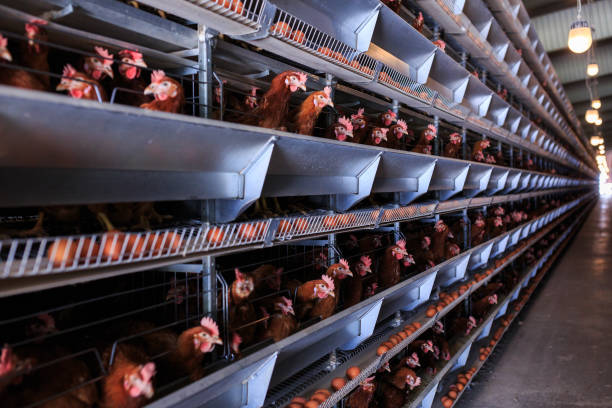
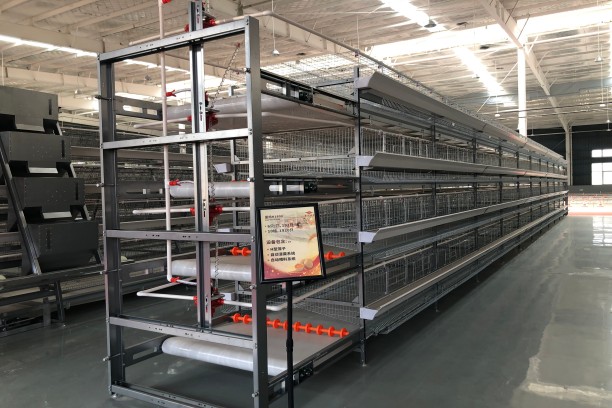
A-type layer cage projects can also integrate automatic feeding, drinking, egg collection and manure-handling equipment depending on the project design.
| Decision Factor | A-Type Layer Cage | H-Type Layer Cage |
|---|---|---|
| Structure | Stepped A-frame arrangement | Vertically stacked arrangement |
| Space Utilization | Uses more horizontal house area for comparable capacity | Uses vertical space more intensively |
| Automation | Can support manual, semi-automatic or automatic configurations | Well suited to integrated automation |
| Project Complexity | Can be relatively simple depending on configuration | Requires closer coordination of multiple equipment systems |
| Investment Decision | Often considered when investment control and flexible automation are priorities | Often considered when space utilization and integrated automation are priorities |
The final decision should therefore use:
rather than selecting a cage solely from the number of birds.
Cost Comparison: Manual vs Semi-Automatic vs Automatic Layer Farm
The following comparison is more useful than assigning a fixed price because equipment and local infrastructure costs vary by project and country.
| Cost Factor | Manual / Basic | Semi-Automatic | Automatic |
|---|---|---|---|
| Initial Equipment Scope | Lower | Medium | Higher |
| Manual Work Requirement | Higher | Medium | Lower for automated functions |
| Electrical Dependency | Lower | Medium | Higher |
| Mechanical Complexity | Lower | Medium | Higher |
| Maintenance Planning | Simpler | Moderate | More important |
| Expansion Coordination | Requires future planning | Flexible depending on design | Should be planned at system level |
| Best Evaluated By | Total project and operating requirements—not cage price alone | ||
These descriptions are relative rather than universal cost rankings. Local wages, electricity prices, farm design, equipment specification and management strategy can change the economics significantly.
How Farm Size Changes the Equipment Decision
One of the most common mistakes is using a fixed rule such as:
or
“50,000 birds must use H-type cages.”
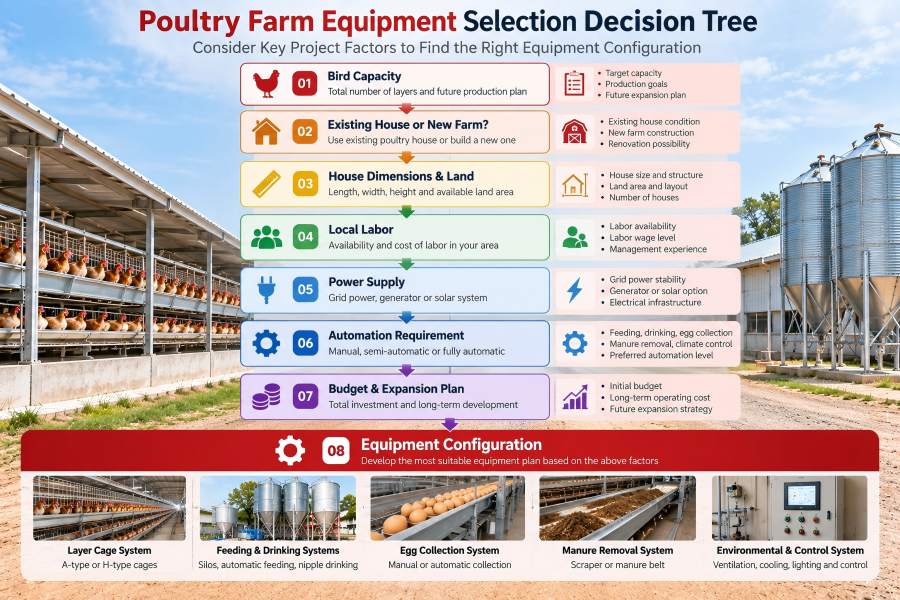
Bird capacity is important, but it is not enough.
Consider two farms with the same number of layers:
Farm A
Existing poultry house, available local labor, limited initial budget and relatively simple operating requirements.
Farm B
New-build poultry houses, limited labor, stronger power infrastructure and a planned expansion strategy.
The two farms can reasonably require different equipment configurations even if their initial bird capacities are identical.
This is why LIVI Machinery uses project inputs rather than a single bird-number threshold when discussing equipment configuration.
How Should You Calculate the Real Cost of Poultry Farm Equipment?
A better cost analysis separates equipment CAPEX from the costs required to make the complete farm operational.
A. Equipment Investment
- layer cage system;
- feeding equipment;
- drinking equipment;
- egg collection equipment;
- manure removal equipment;
- feed silos and conveying equipment;
- ventilation and environmental equipment where required;
- lighting and control equipment.
B. Poultry House and Infrastructure
- poultry-house construction;
- foundations and civil works;
- water storage and distribution;
- electrical infrastructure;
- backup power;
- roads and site access;
- feed and egg storage;
- manure and waste handling.
C. Logistics and Implementation
- international or domestic freight;
- customs and local transport where applicable;
- installation;
- commissioning;
- operator training;
- initial spare parts.
D. Operating Costs
- feed;
- labor;
- electricity and fuel;
- maintenance;
- water;
- replacement parts;
- biosecurity and farm-management expenses.
WOAH recommends that intensive poultry establishments operate with formal biosecurity procedures and written biosecurity plans. This is another reason a realistic commercial farm budget should extend beyond the purchase price of cages and machinery.
Want to Compare the Cost of Different Automation Levels?
Send LIVI your bird capacity, country, poultry-house dimensions and required systems. We can define the equipment scope first so you can compare quotations on the same basis.
How to Compare Poultry Equipment Quotations Correctly
Once several quotations arrive, do not compare only the number at the bottom of each document.
Build a quotation comparison sheet.
| Check | Questions to Ask |
|---|---|
| Bird Capacity | What is the nominal capacity per cage set and total project capacity? |
| Cage Specification | What cage model, dimensions, tiers and configuration are quoted? |
| Feeding | Are silos, conveying and automatic feeders included? |
| Drinking | What drinking and water-regulation equipment is included? |
| Egg Collection | Manual, row-level automatic or central collection? |
| Manure | What manure-removal equipment and discharge interfaces are included? |
| Environment | Are ventilation, cooling and controls included or excluded? |
| Electrical | Are motors and control cabinets included, and what power conditions are required? |
| Shipping | Which trade term and destination does the price cover? |
| Installation | Is installation included, supervised or buyer-managed? |
| After-Sales | What technical support and spare-part scope is provided? |
A complete poultry equipment quotation becomes useful only when these boundaries are clear.
Which System Should You Choose?
There is no universal winner between manual and automatic poultry equipment.
Consider a Simpler Configuration When:
- initial investment is strongly constrained;
- the farm is relatively small;
- labor is readily available;
- power infrastructure is limited;
- the owner wants to automate gradually.
Consider More Automation When:
- the project operates at larger commercial scale;
- routine manual operations become difficult to manage;
- labor availability or management consistency is a concern;
- reliable electricity and technical support are available;
- the farm is designed for integrated equipment from the beginning;
- future expansion is part of the project plan.
Between these two options is a third path: semi-automatic poultry equipment.
For some investors, automating the most management-intensive processes first while retaining simpler systems elsewhere can provide a practical phased investment strategy.
LIVI Machinery can configure A-type or H-type layer projects with different automation scopes according to the actual farm rather than forcing every project into the same equipment package.
Frequently Asked Questions About Poultry Farm Equipment Cost
1. Is automatic poultry farm equipment more expensive than manual equipment?
An automatic system normally includes a larger equipment scope, such as automatic feeding, egg collection, manure removal, conveying equipment, motors and controls. However, the investment decision should compare both initial equipment cost and long-term operating requirements rather than purchase price alone.
2. How much does an automatic poultry farm cost?
There is no reliable universal price based only on bird capacity. Cost depends on cage type, flock size, automation level, poultry-house construction, feeding and drinking equipment, egg collection, manure removal, environmental control, electricity, freight and installation scope.
3. Is a manual or automatic system better for 10,000 layers?
Bird capacity alone cannot determine the best configuration. A 10,000-layer project should also be evaluated by poultry-house dimensions, local labor, electricity, available budget and future expansion. Manual, semi-automatic and automatic configurations can all be considered depending on those conditions.
4. Does automation reduce poultry farm labor requirements?
Automation transfers specific repetitive operations such as feed distribution, egg movement or manure removal from manual work to mechanical systems. The actual labor requirement still depends on farm scale, management structure and which functions have been automated, so a fixed labor-saving percentage should not be assumed without project data.
5. What is the difference between A-type and H-type layer cage cost?
The cost difference depends on cage configuration, capacity, quantity and supporting automation. A-type systems offer flexible automation options, while H-type systems are well suited to intensive vertically stacked layouts and integrated automation. A project-specific quotation is needed for a meaningful comparison.
6. What should a complete poultry equipment quotation include?
Buyers should check cage specifications and quantities, feeding, drinking, egg collection, manure removal, silos and conveying equipment, environmental systems where required, electrical controls, spare parts, shipping terms, installation scope and technical support.
7. How can I calculate poultry farming ROI or payback period?
Start by separating total CAPEX from recurring OPEX, then build a production and revenue model using local feed prices, labor, electricity, replacement costs, egg prices and realistic production assumptions. Because these variables differ by country and farm, a fixed ROI or payback period should not be promised from equipment price alone.
Compare Poultry Equipment Cost Before You Invest
The cheapest equipment quotation is not necessarily the lowest-cost farm, and the most automated system is not automatically the best investment.
A useful comparison starts with the actual project:
Once these inputs are defined, investors can compare manual, semi-automatic and automatic poultry equipment on the same basis.
Planning a Commercial Layer Farm?
Send LIVI your country, target bird capacity, poultry-house dimensions and preferred automation level. LIVI Machinery can prepare an equipment configuration and quotation for project-specific comparison.