



For most investors, the useful question is not simply:
“How much are cages for 10,000 chickens?”
A better question is:
The answer depends primarily on the cage system, automation level, whether the poultry house already exists, local construction conditions, power reliability, logistics and the exact equipment included in the supplier’s quotation.
What Makes Up the Cost of a 10,000-Layer Farm?
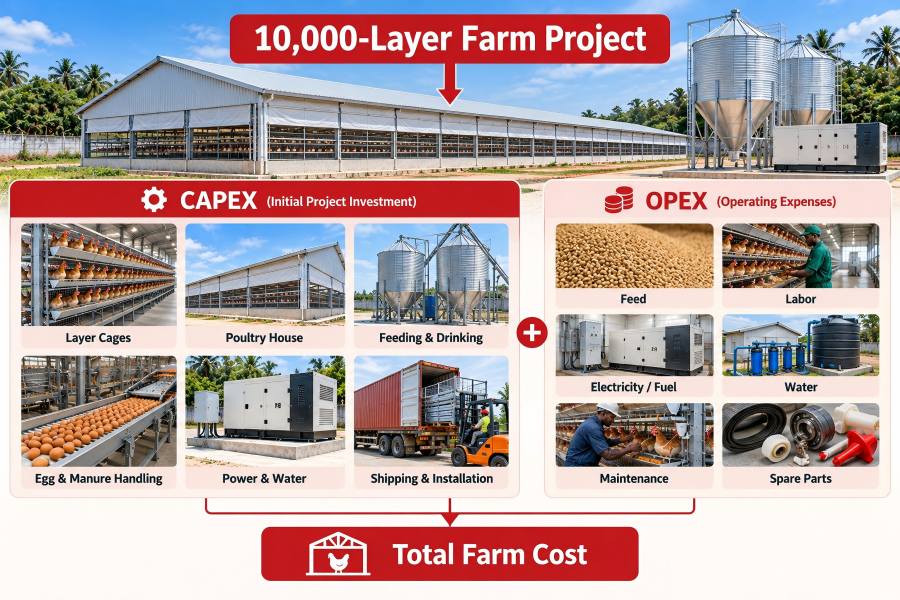
A commercial layer project has several cost layers. The easiest way to understand them is to separate the investment into CAPEX and OPEX.
Initial Project Investment — CAPEX
- Land and site preparation
- Poultry-house construction
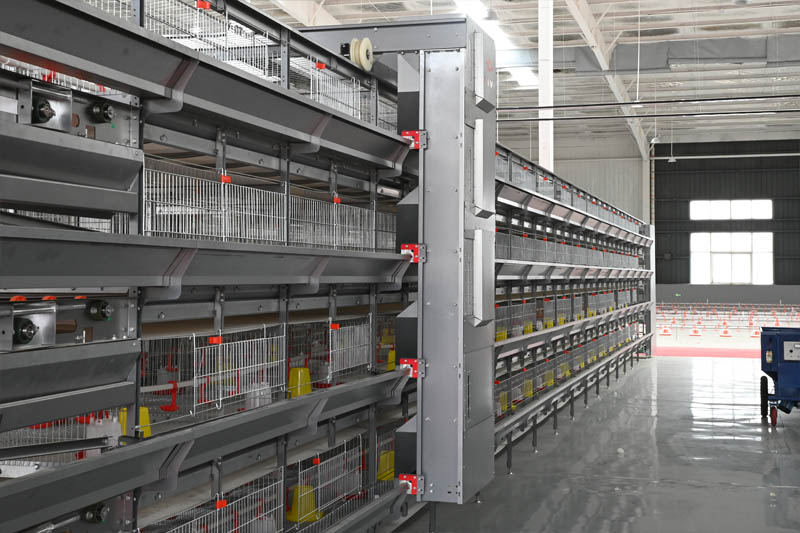
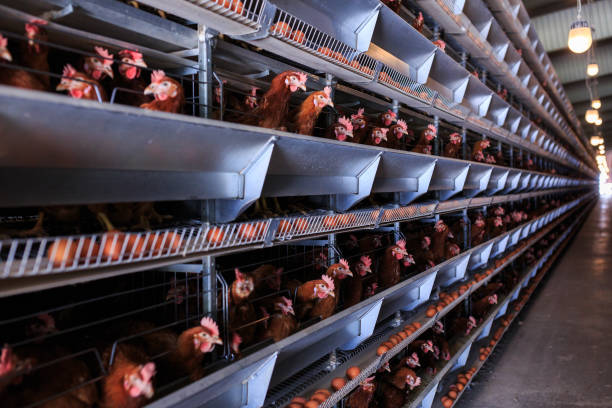
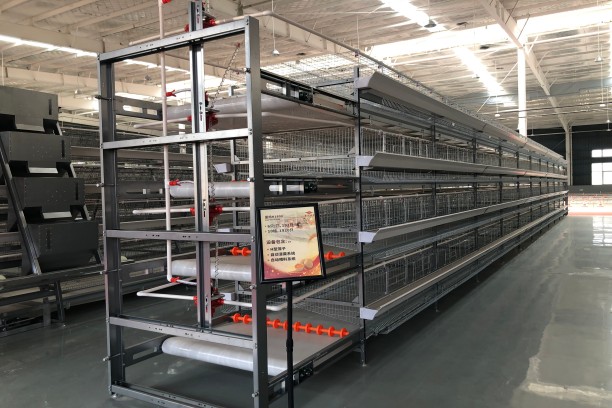
- Layer cage system
- Feeding and drinking equipment
- Manure handling
- Egg collection
- Feed storage
- Electrical system
- Water infrastructure
- Ventilation and environmental control
- Backup power
- Freight and inland transport
- Installation and commissioning
Farm Operating Cost — OPEX
After birds enter production, the farm also needs to budget for feed, labor, electricity and generator fuel, water, maintenance, replacement parts, flock inputs, sanitation, biosecurity, manure management and other recurring farm expenses.
This distinction matters because a low equipment quotation does not automatically mean a low-cost poultry business.
Layer Cage System: One of the First Equipment Costs to Calculate
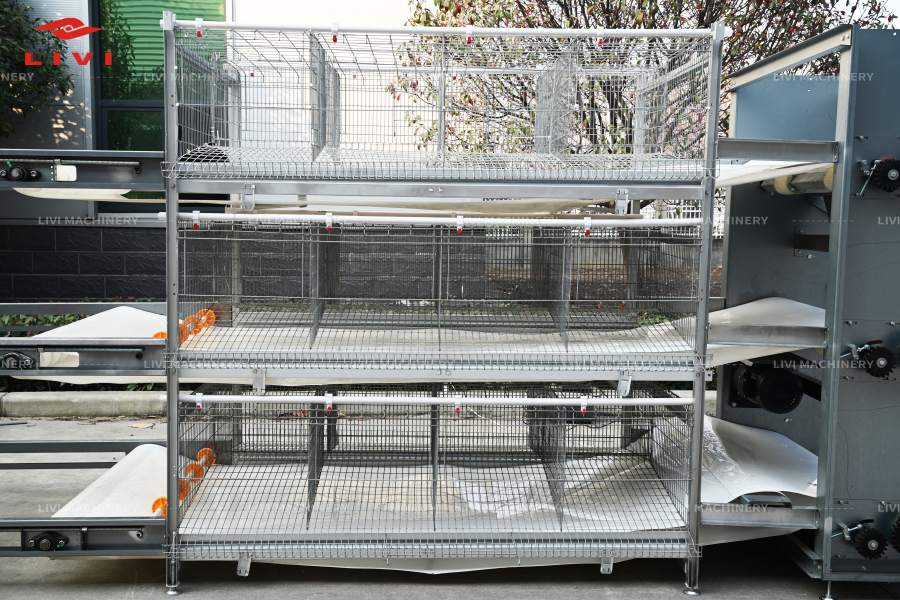
The cage system establishes the basic bird-housing capacity of the project. But asking only for the battery cage price in Nigeria can produce misleading comparisons.
A useful cage quotation should specify:
| Item | What to Confirm |
|---|---|
| Cage Type | A-Type or H-Type |
| Cage Dimensions | Actual L × W × H |
| Configuration | Tiers and doors |
| Capacity | Birds per set |
| Quantity | Total cage sets |
| Total Positions | Nominal farm capacity |
| Material / Specification | Confirm with manufacturer |
| Supporting Equipment | Included or excluded |
For example, two suppliers may both describe their offer as a “10,000-layer cage system,” while the actual cage dimensions, number of sets and equipment included are different.
This is more useful than simply comparing Supplier A’s total price with Supplier B’s total price.
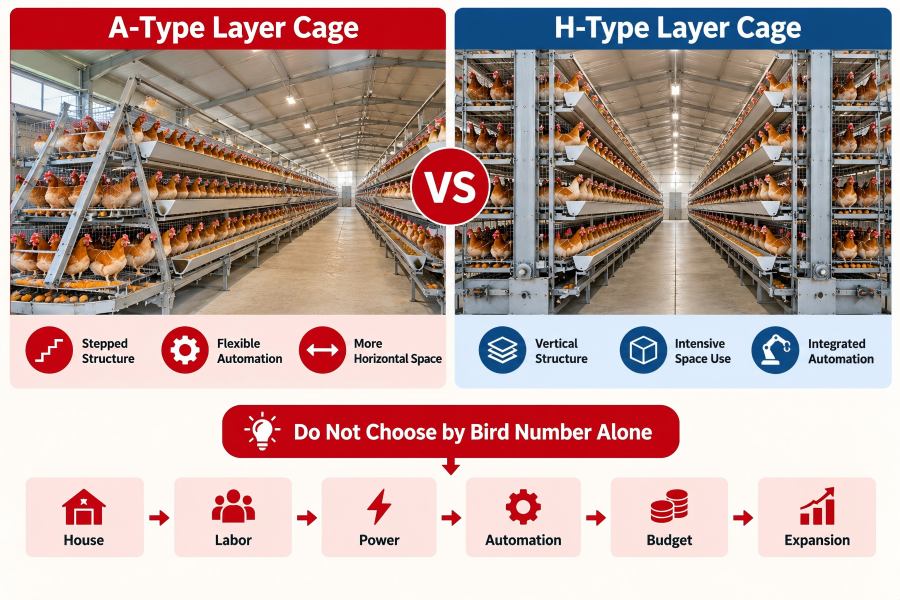
A-Type vs H-Type Layer Cage: How Does the Choice Affect Cost?
One of the most common questions from Nigerian buyers is whether a 10,000-layer farm should use A-type or H-type cages.
There is no universal answer.
| Decision Factor | A-Type Layer Cage | H-Type Layer Cage |
|---|---|---|
| Structure | Stepped A-frame arrangement | Vertically stacked arrangement |
| Space Use | Uses more horizontal house area for comparable capacity | Uses vertical space more intensively |
| Automation | Can support manual, semi-automatic or automatic configurations | Well suited to integrated automation |
| Project Complexity | Can remain relatively simple depending on configuration | Requires closer coordination of equipment systems |
| Investment Focus | Flexible automation and investment control | Space utilization and integrated automation |
An A-type project can incorporate different levels of mechanization, while an H-type project can integrate feeding, drinking, egg collection and manure handling into a vertically intensive layout.
However, bird number alone should not decide the cage type.
Buyers can compare the LIVI A-Type Layer Cage System and LIVI H-Type Layer Cage System before deciding which configuration better matches the project.
Automation Level Can Change the Equipment Budget Significantly
A 10,000-layer project can have very different equipment scopes. This is one of the main reasons that two quotations for the same bird capacity can differ substantially.
| System | Basic / Manual | Semi-Automatic | Higher Automation |
|---|---|---|---|
| Layer Cages | Yes | Yes | Yes |
| Nipple Drinking | Possible | Common | Common |
| Feeding | Manual | Mechanized | Automatic |
| Egg Collection | Manual | Depends on design | Automatic |
| Manure Removal | Basic / manual | Mechanized | Automatic |
| Control Equipment | Limited | Moderate | More integrated |
| Electrical Dependency | Lower | Medium | Higher |
| Initial Equipment Scope | Lower | Medium | Higher |
This comparison does not mean one level is universally better.
A farm with available labor and limited power infrastructure may reach a different investment decision from a farm where labor is difficult to manage and reliable backup power is already available.
FAO notes that as poultry production progresses toward medium- and large-scale commercial operations, greater use is generally made of commercial equipment, mechanization and automation. This does not establish a universal bird-number threshold for automation; it reinforces the need to evaluate farm scale together with management and environmental requirements.
Therefore, when asking for an automatic layer farm cost Nigeria, define exactly what “automatic” includes.
For a more detailed cost comparison, see LIVI’s automatic vs manual poultry farm equipment cost guide.
Poultry House Construction Is a Separate Major Cost
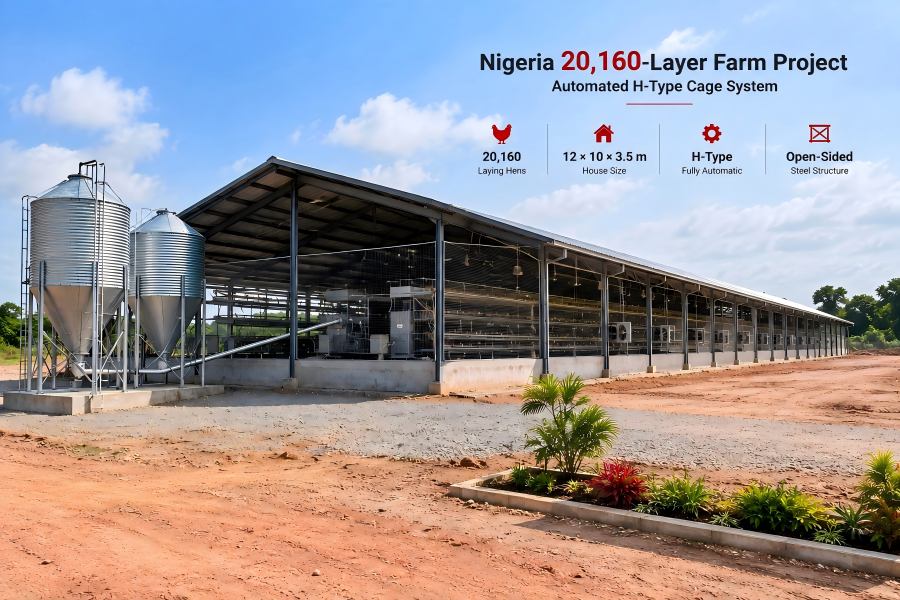
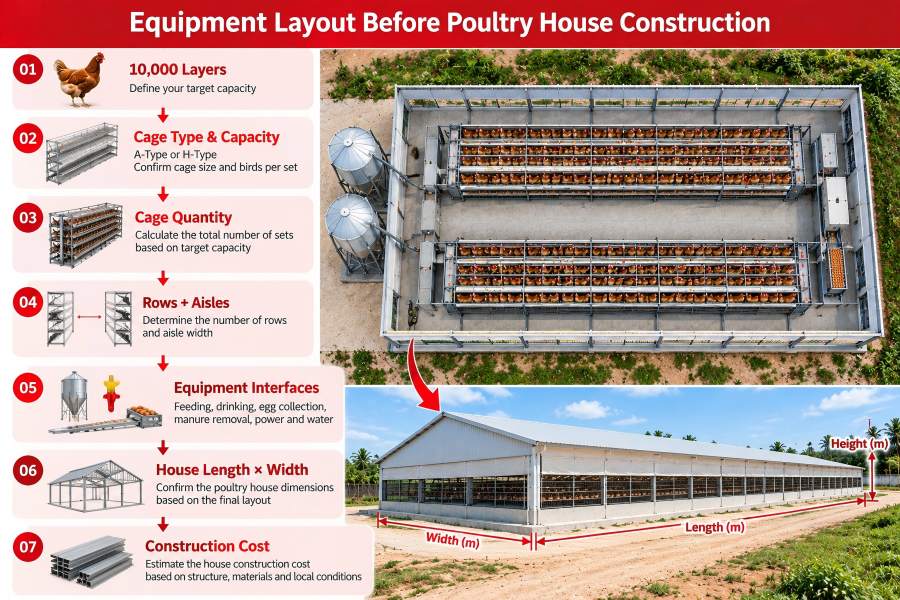
Equipment is only part of the investment. A new farm also needs a poultry house designed around the selected cage configuration.
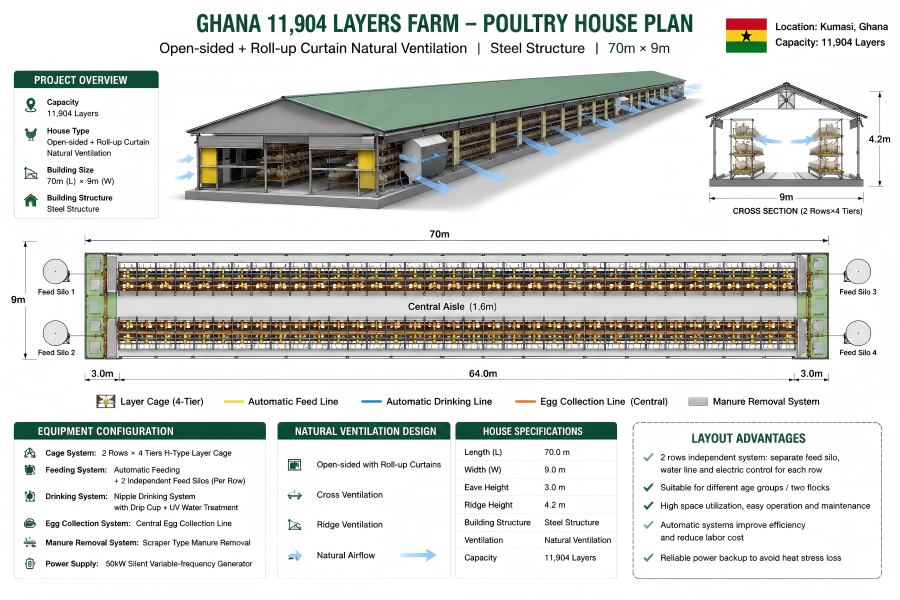
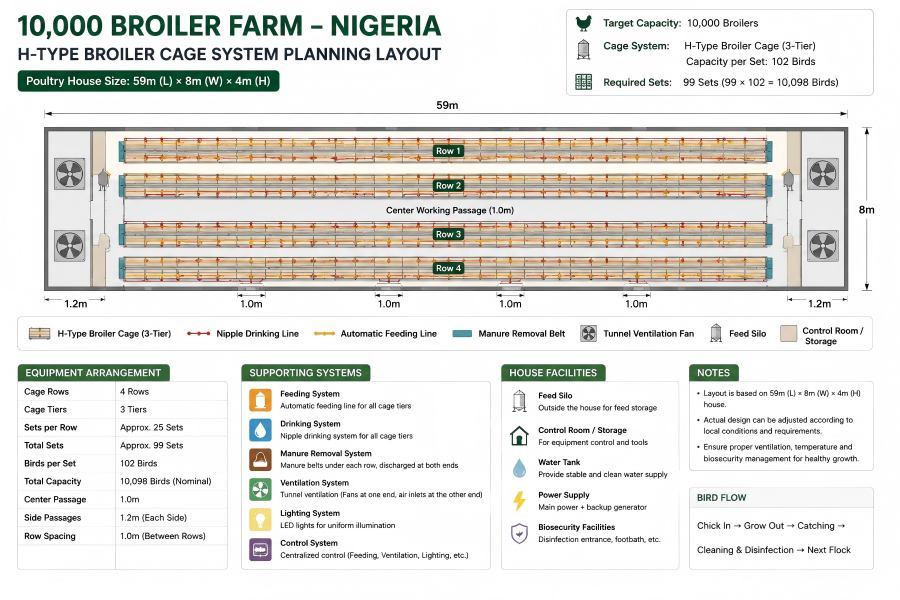
For a 10,000-layer project, the house dimensions should not be selected from bird capacity alone.
House construction cost can then be affected by the steel structure, house length and width, roof and wall materials, open or semi-open design, insulation, curtains, foundations, drainage and electrical installation.
FAO poultry housing guidance identifies temperature, humidity, air movement, feed, water and disease exposure as important elements of the poultry environment.
For Nigerian investors, this means poultry house construction cost in Nigeria should be evaluated together with cage layout and environmental requirements rather than estimated independently.
Power Supply Can Become a Hidden Project Cost
Electricity becomes increasingly important when a farm uses motorized feeding, manure removal, egg collection, water pumps or mechanical environmental-control equipment.
A farm may therefore need to budget for:
This creates both initial investment and recurring operating cost.
How Should Generator Size Be Calculated?
Generator size should not be estimated using a rule such as “10,000 birds require X kVA.”
Instead, calculate:
A basic cage farm and a highly automated 10,000-layer farm can have very different electrical requirements.
For this reason, electricity conditions should be included in the project information sent to the poultry equipment supplier before the final system is configured.
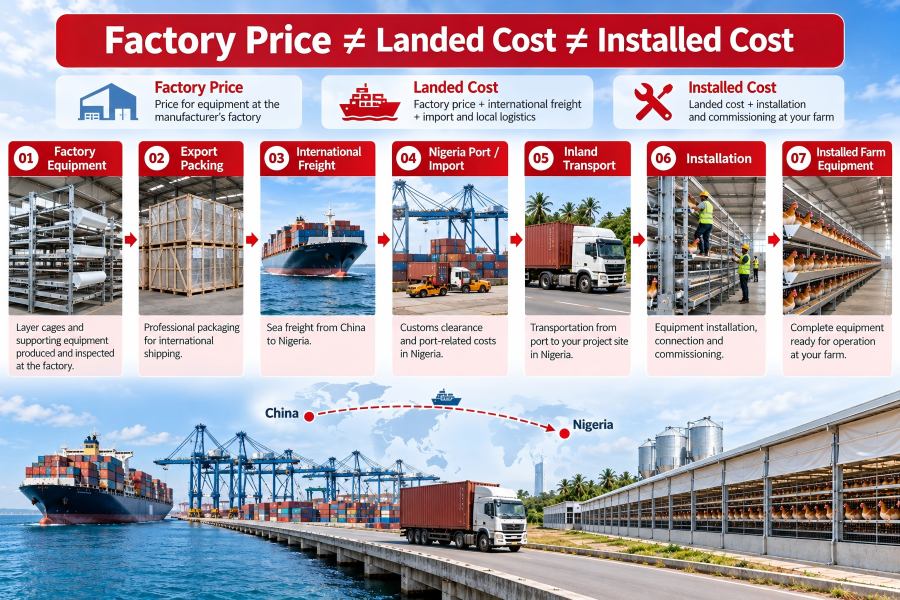
Shipping from China to Nigeria: Factory Price Is Not Landed Cost
Another common budgeting mistake occurs when investors compare the Chinese factory quotation directly with the final cost at the farm.
They are not the same figure.
This distinction is particularly important for buyers researching poultry equipment shipping cost China to Nigeria or poultry equipment landed cost Nigeria.
Before accepting a quotation, confirm the trade term, port or delivery destination, container requirements, shipment scope, local cost exclusions and installation responsibilities.
Need a Cost Plan for a 10,000-Layer Farm?
Send LIVI your project location, available land or poultry-house dimensions, preferred cage type and automation requirements. Define the equipment scope first before comparing project prices.
What Are the Main Operating Costs After the Farm Is Built?
Initial investment is only half of the financial picture. For commercial egg production, ongoing costs can determine whether the project remains financially sustainable.
Feed
Feed is a major recurring input in layer production. Actual cost depends on feed formulation, local ingredient prices, feed sourcing strategy, bird age and consumption.
Annual feed cost should therefore not be calculated from an arbitrary universal number without confirming the production assumptions.
Labor
Manual farms may require more routine human involvement in feeding, egg handling and manure management.
Automation changes the type and amount of labor required, but it also introduces electrical and maintenance requirements.
Electricity and Fuel
Motorized systems consume electricity, while unreliable grid supply can create additional generator fuel and maintenance costs.
Maintenance and Spare Parts
Motors, chains, belts, bearings, sensors and other components require inspection and replacement according to the installed system.
Working Capital
A farm also needs sufficient cash to operate between initial stocking and regular egg-sales cash flow.
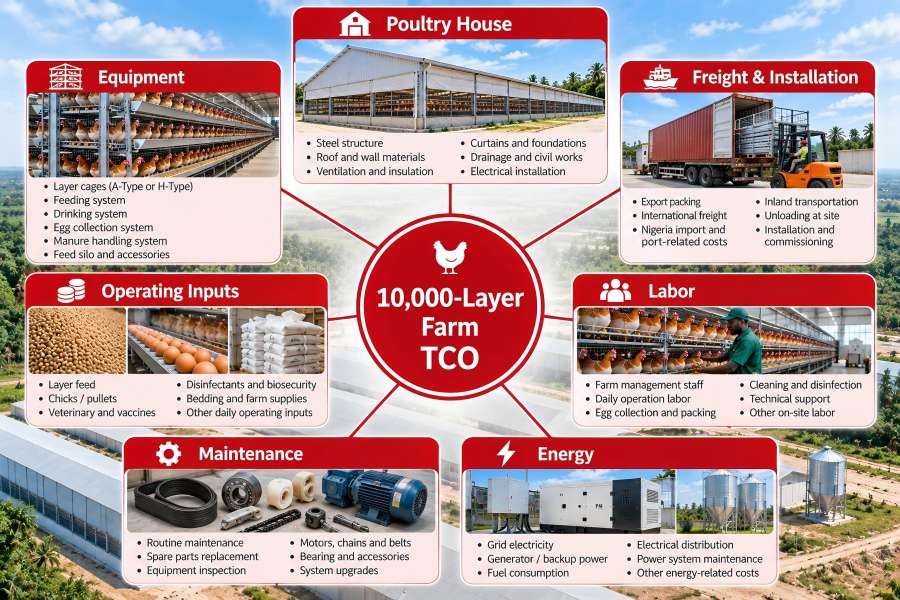
What Is the Total Cost of Ownership of a 10,000-Layer Farm?
The equipment purchase price is only one component of the farm’s total cost of ownership.
+ Poultry House & Infrastructure
+ Freight & Installation
+ Energy
+ Labor
+ Maintenance & Spare Parts
+ Operating Inputs
= Total Cost of Ownership
This changes how two poultry equipment quotations should be evaluated.
Quotation A
Lower equipment price, but excludes several supporting systems, freight and installation.
Quotation B
Higher initial quotation, but includes more of the required equipment and implementation scope.
It would be incorrect to conclude that Quotation A is cheaper without normalizing what each supplier actually provides.
LIVI’s current cost analysis makes the same distinction between initial equipment investment and the wider operating requirements of manual, semi-automatic and automatic poultry farms.
How Can You Get a More Accurate 10,000-Layer Farm Quotation?
A supplier cannot prepare a meaningful commercial farm quotation from the sentence:
“Please send price for 10,000 chickens.”
Provide the project inputs first.
| Project Input | Why the Supplier Needs It |
|---|---|
| Country & Project Location | Climate, logistics and local project conditions |
| Target Capacity | Cage quantity and system capacity |
| Existing or New House | Determines design freedom and construction requirements |
| House Dimensions / Available Land | Determines rows, aisles and equipment layout |
| Cage Preference | A-Type, H-Type or comparative planning |
| Automation Level | Defines feeding, drinking, egg and manure equipment scope |
| Power Conditions | Electrical and backup-power planning |
| Expansion Plan | Allows infrastructure to consider future phases |
| Delivery Destination | Required for logistics calculations |
With these inputs, a poultry equipment supplier can prepare a configuration instead of simply quoting a cage price.
How to Compare Poultry Equipment Suppliers
Price matters, but a commercial farm buyer should evaluate more than the invoice total.
Ask each manufacturer to provide the same information:
| Comparison Item | Buyer Should Verify |
|---|---|
| Cage Specification | Exact dimensions and configuration |
| Nominal Capacity | Birds per set × total sets |
| Equipment Scope | Included and excluded systems |
| Layout | Compatibility with the poultry house |
| Power Requirements | Installed equipment loads |
| Spare Parts | Initial supply and future availability |
| Installation | Supplier and customer responsibilities |
| Shipping | Trade term and destination |
| Documentation | Drawings and technical information |
| After-Sales | Technical support process |
LIVI Machinery can configure A-type or H-type layer projects with different automation scopes according to the actual poultry house, farm conditions and investment requirements rather than forcing every 10,000-layer project into the same equipment package.
Seven Common Costing Mistakes to Avoid
1. Budgeting Only for Cages
The cage is not the complete poultry farm. House construction, water, electricity, manure handling, egg handling, logistics and working capital can all sit outside the cage quotation.
2. Comparing Different Supplier Scopes
Cages only cannot be directly compared with cages plus feeding, drinking, manure removal and egg collection. Normalize the scope first.
3. Building the House Before Finalizing the Equipment Layout
This can create unsuitable row spacing, insufficient equipment clearances or unnecessary construction area.
4. Choosing Automation Without Checking Power
Automation and power infrastructure must be planned together.
5. Ignoring Freight and Inland Logistics
Factory price is not farm-gate cost.
6. Spending the Entire Budget on CAPEX
The farm still needs working capital after construction.
7. Choosing Only by Lowest Price
A lower quotation may simply contain fewer components.
How Can You Reduce the Cost of a 10,000-Layer Project?
Cost optimization should remove unnecessary expenditure—not necessary engineering.
- Optimize the layout first. Determine the cage configuration before fixing poultry-house dimensions.
- Define the automation level. Select systems based on the farm’s operating model rather than automatically choosing either maximum automation or minimum equipment.
- Separate imported and local scope. Determine which equipment should come from the manufacturer and which infrastructure can reasonably be sourced locally.
- Plan power correctly. Match backup infrastructure to actual electrical loads.
- Reserve realistic expansion interfaces. If future expansion is planned, consider land, roads, electrical distribution and equipment interfaces before Phase 1 construction.
- Request comparable quotations. Use the same capacity, specification and equipment boundary when comparing suppliers.
The objective is not necessarily the lowest initial poultry equipment price in Nigeria.
It is a project scope that the investor can understand, finance, install, operate and maintain.
Compare Your 10,000-Layer Project Options
Send LIVI the same capacity, house information, automation requirements and delivery location you are using for other quotations. This makes equipment and project cost comparisons more meaningful.
Frequently Asked Questions About 10,000 Layer Farm Cost in Nigeria
1. How much does it cost to start a 10,000-layer farm in Nigeria?
There is no reliable universal amount. Cost depends on cage type, poultry-house construction, automation, power, water, freight, installation and local infrastructure. A project-specific quotation should be based on the actual farm conditions.
2. How much are battery cages for 10,000 layers in Nigeria?
The price depends on cage dimensions, capacity per set, total number of sets, material specification and included equipment. Compare quotations using the same cage capacity and supply scope.
3. Is A-type or H-type cheaper for a 10,000-layer farm?
The final cost depends on cage configuration, capacity, equipment scope and automation rather than the cage name alone. A-type and H-type systems should be compared using the same farm requirements and quotation boundary.
4. What poultry house size do I need for 10,000 layers?
There is no universal house dimension based only on bird number. Cage model, number of rows, aisles, equipment clearances, ventilation and service space should be determined first.
5. What generator size is required for a 10,000-layer farm?
Calculate generator capacity from the actual electrical load, motor starting requirements, simultaneous operation and critical backup loads. Bird number alone is insufficient.
6. Does a poultry equipment quotation include shipping to Nigeria?
Not always. Confirm the Incoterm, destination, international freight, Nigerian inland transport, unloading and installation responsibilities before comparing prices.
7. Is a fully automatic 10,000-layer farm worth the extra cost?
That depends on labor availability and cost, electricity reliability, operating strategy, maintenance capability, expansion plans and budget. Automation should be evaluated through total project and operating requirements rather than initial equipment price alone.
Price Is Only Useful When the Project Scope Is Clear
The biggest lesson for investors planning a 10,000-layer farm is simple:
Do not ask for one poultry-farm price before defining what the price needs to include.
A realistic investment decision follows this chain:
This makes it possible to compare a layer cage price in Nigeria, a complete equipment quotation and an installed poultry-farm investment without confusing three very different cost boundaries.
For LIVI Machinery, the starting point for a useful quotation is not simply “10,000 birds.” It is the combination of capacity + house + location + automation + power + delivery destination + expansion plan.
Planning a 10,000-Layer Farm in Nigeria?
Send LIVI your project location, target capacity, existing poultry-house dimensions or available land, preferred automation level and power conditions. LIVI Machinery can use these inputs to prepare an equipment configuration and project-specific quotation.