


How Should a 60,000-Bird Broiler Farm Be Planned Without Grid Electricity?
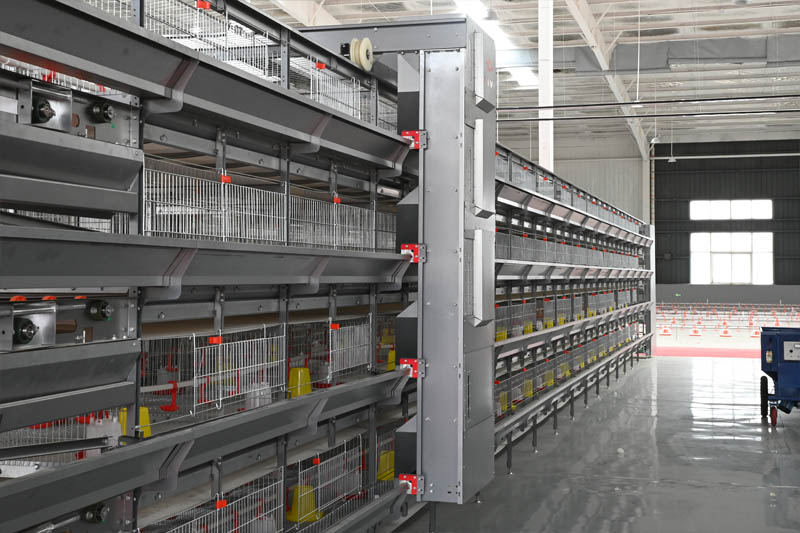
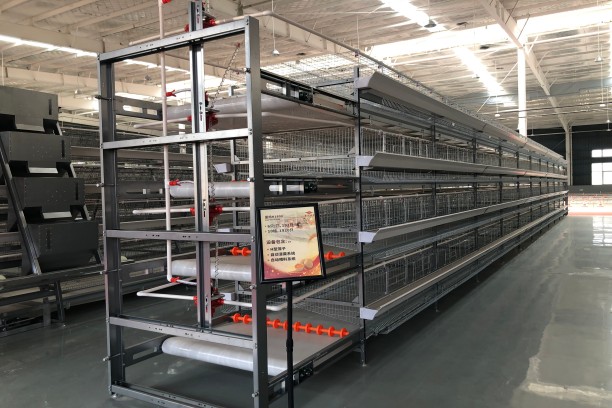
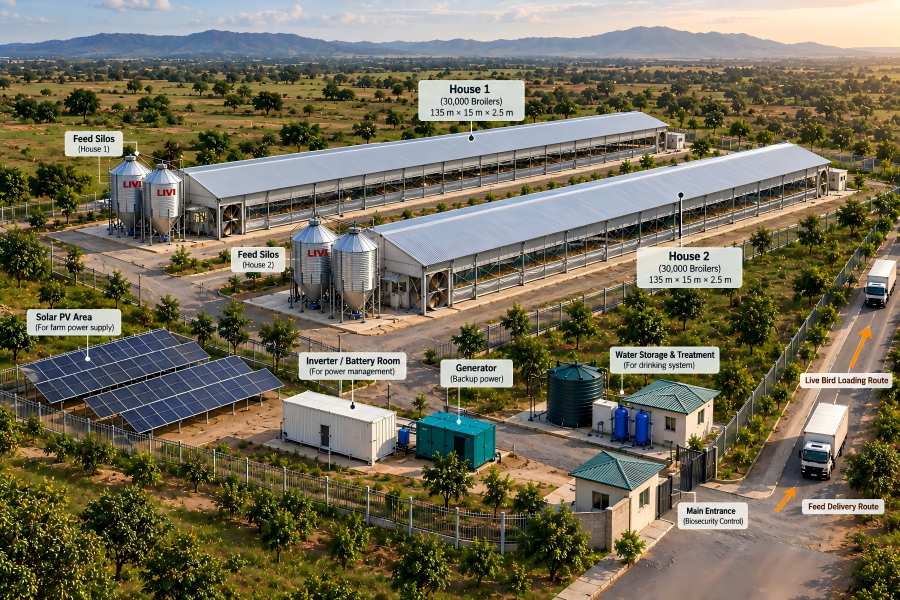
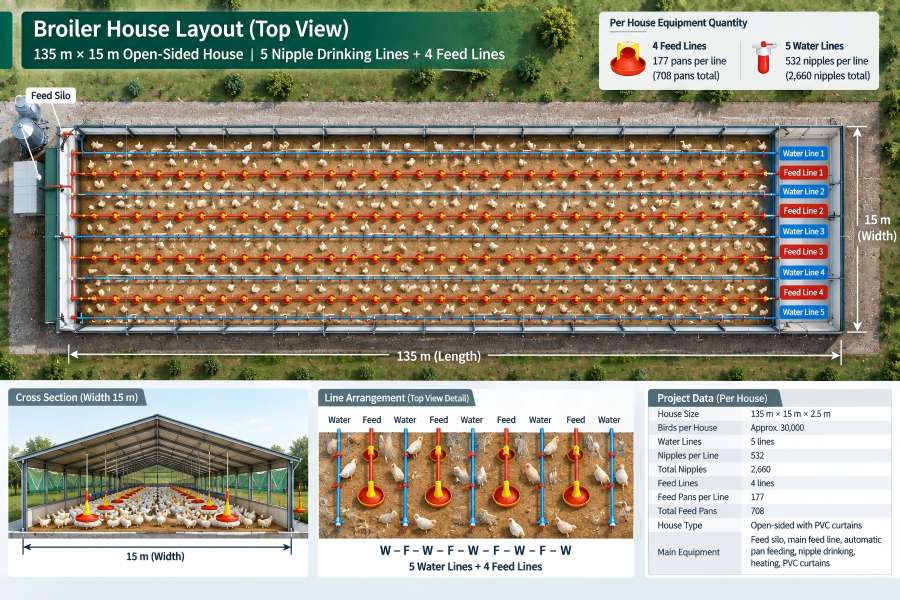
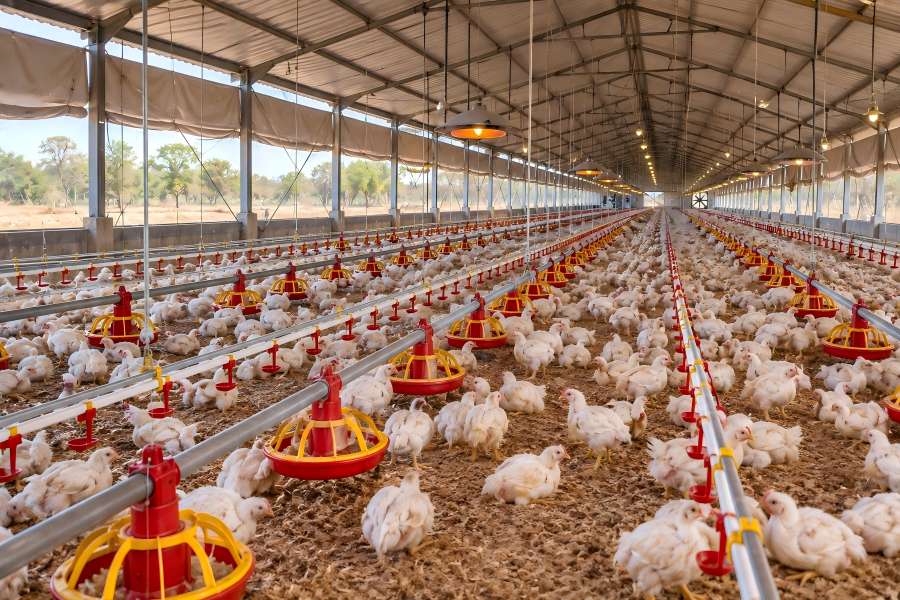
A 60000 broiler farm in Zimbabwe can be divided into two independent 30,000-bird production houses, each measuring 135 × 15 × 2.5 m. The confirmed floor-rearing equipment plan uses five nipple drinking lines with 532 nipples per line and four automatic feeding lines with 177 pans per line in each house.
The main project challenge is not only bird capacity. The farm has no utility-grid connection, so feeding, drinking, heating, lighting and other electrical loads must be classified before the energy system is selected. For this project, a hybrid strategy combining solar PV, battery-supported critical loads and generator backup is more appropriate than relying on either solar or a generator alone.
Production economics should also be planned by batch. A 42-day growing period can be used as a planning benchmark, followed by cleaning, disinfection and downtime before the next flock. However, survival rate, feed intake, market weight, feed price and selling price must remain scenario inputs until the actual chick breed, feed program and buyer contract are confirmed.
Why Divide 60,000 Broilers Between Two Houses?
This project uses two open-sided broiler houses instead of concentrating all 60,000 birds inside one building.
Each house has a gross floor area of:
At approximately 30,000 birds per house, the gross planning density is:
This is a planning calculation, not a final stocking-density recommendation. Final stocking density must be checked against market weight, climate, ventilation capacity, litter management, bird welfare requirements and the customer’s production standard.
The two-house structure also creates two identifiable production units. Feeding, drinking, heating and curtain management can be checked house by house rather than treating 60,000 birds as one undivided equipment load.
How Should Feeding and Drinking Lines Be Arranged?
A commercial broiler floor-rearing house needs to distribute feeding and drinking access throughout the usable floor area rather than concentrating birds around a small number of points.
The confirmed equipment configuration for each 135 m house is:
| Equipment | Per House | Two-House Total |
|---|---|---|
| Broilers | Approx. 30,000 | Approx. 60,000 |
| Nipple Drinking Lines | 5 | 10 |
| Nipples per Line | 532 | — |
| Total Nipples | 2,660 | 5,320 |
| Automatic Feeding Lines | 4 | 8 |
| Feed Pans per Line | 177 | — |
| Total Feed Pans | 708 | 1,416 |
Drinking-Point Planning Check
Feed-Pan Planning Check
These calculations are useful for checking whether the equipment quantity corresponds logically with the planned flock. They do not replace the equipment manufacturer’s operating recommendations, bird-age adjustments or actual house commissioning.
The LIVI broiler pan feeding system connects feed storage and conveying with automatic pan distribution throughout the house. The equipment route should be planned as:
For product specifications and system components, see the LIVI Broiler Pan Feeding System .
Why Use Five Drinking Lines and Four Feeding Lines?
The project deliberately uses one more drinking line than feeding line.
For a 15 m wide floor-rearing house, this allows water and feed access to be distributed across the width instead of placing all resources along a limited number of longitudinal routes.
The exact lateral spacing should be confirmed in the final layout drawing together with wall clearance, brooding zones, service access and equipment suspension positions.
The drinking system should also be treated as more than 2,660 individual nipples. A complete commercial water route should consider:
The LIVI automatic poultry drinking system can integrate nipple drinkers, pressure control, drinking pipes, lifting components and medication equipment according to the final farm design.
See the Automatic Poultry Drinking System for the system structure and selection factors.
How Should an Open-Sided Broiler House Handle Changing Weather?
The confirmed poultry-house concept is open-sided and uses PVC curtains together with heating. This means environmental management changes with bird age, outside temperature, wind and weather.
PVC curtains provide a controllable building interface. They can be adjusted as conditions change, but they should not be treated as a substitute for a complete ventilation strategy.
Brooding Stage
Young chicks require a carefully managed thermal environment. The heating system therefore needs to be coordinated with curtain position, air exchange and the brooding area.
Growing Stage
As birds grow, metabolic heat and moisture output increase. The environmental priority shifts toward removing excess heat, moisture and stale air while maintaining suitable conditions at bird level.
The final solution should therefore evaluate:
- local temperature and seasonal conditions;
- prevailing wind;
- house orientation;
- 15 m house width;
- bird age and target market weight;
- stocking density;
- curtain operating strategy;
- whether supplementary mechanical ventilation is required.
The farm should not assume that “open-sided” means “no ventilation equipment required.” Environmental design must be confirmed from actual site conditions.
The Critical Question: How Should an Off-Grid Broiler Farm Be Powered?
This project has no utility-grid electricity connection.
That changes the project design significantly because electricity is no longer a secondary building service. It becomes part of the production infrastructure.
Zimbabwe’s current national energy strategy supports greater use of distributed renewable energy, mini-grids and standalone systems. The country’s National Energy Compact also identifies a substantial role for off-grid electrification and targets continued expansion of renewable generation.
For this farm, the practical question is therefore not simply: “Solar or generator?”
A better question is:
Recommended Architecture: Solar + Battery + Generator
↓
Battery Storage → Critical / Continuity Loads
↓
Generator → Backup + High Load + Low-Solar Emergency Operation
For a remote commercial farm, this hybrid architecture is generally more resilient than designing the project around solar-only or generator-only operation.
Why Is Solar + Generator More Suitable Than Generator-Only?
Zimbabwe’s electricity sector continues to face reliability constraints. ZETDC explains that load shedding is used when available generation cannot meet demand and also notes that unplanned system events can require supply interruptions outside published schedules.
For this project the site currently has no grid connection at all, so grid reliability is not the immediate operating issue. The more relevant lesson is that the farm should be designed for energy independence from the beginning rather than assuming a future grid connection will solve its production requirements.
Zimbabwe’s National Energy Compact supports standalone and distributed renewable-energy systems, while the national renewable-energy framework provides a policy basis for solar deployment.
Recommended Load Hierarchy
| Load Group | Planning Priority | Preferred Energy Logic |
|---|---|---|
| Controls / Sensors | Continuity | Solar + Battery + Generator Backup |
| Water Pump / Water Supply | Critical | Solar / Battery where suitable + Generator Backup |
| Automatic Feeding | Scheduled Motor Load | Operate during planned generation windows; generator backup available |
| Lighting | Scheduled / Critical by Production Stage | Solar + Battery |
| Ventilation Equipment if Required | Potentially Critical | Generator-backed electrical circuit |
| Heating | High Priority During Brooding | Final strategy depends on the confirmed heating energy source |
What Size Solar System and Generator Does the Farm Need?
There is not enough confirmed information to specify a responsible kW, kWh or kVA figure yet.
The correct engineering sequence is:
The customer should therefore provide the final motor list, pump specifications, lighting, heating source and any planned ventilation equipment before the electrical system is sized.
How Long Is One Broiler Production Cycle?
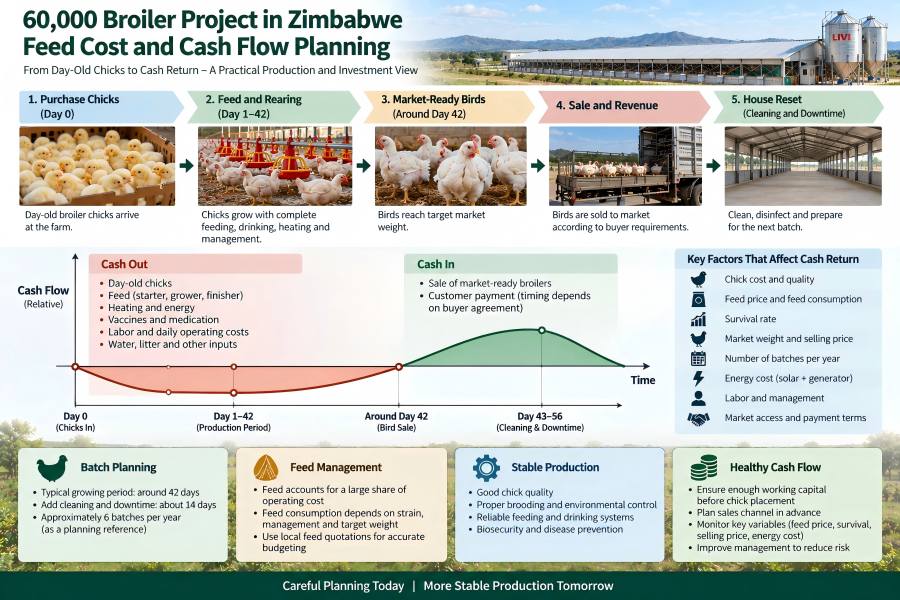
Broiler production should be planned as a repeating cash-conversion cycle rather than as a continuous production process.
Because the project has not yet confirmed the broiler strain, target slaughter weight or buyer specification, the production calendar below is a planning model rather than a guaranteed result.
| Stage | Planning Window | Main Management Focus |
|---|---|---|
| Placement / Brooding | Day 0–14 | Heating, chick access to feed and water, early management |
| Growth | Day 15–28 | Feed and water access, litter, environment, flock development |
| Finishing | Day 29–42 | Feed intake, environmental load, target market weight |
| Sale / Depletion | Around Day 42 or buyer target | Bird loading, sale and house emptying |
| Cleaning / Disinfection / Downtime | Planning allowance: 10–14 days | Cleaning, drying, maintenance and preparation for next flock |
Using a conservative planning calendar of approximately 42 growing days plus 14 days for depopulation, cleaning, disinfection, maintenance and preparation gives:
The mathematical maximum is slightly higher, but an investment model should not assume perfect turnaround with no delays. Six full production cycles per year is a more useful starting scenario until the customer’s actual production schedule is confirmed.
Should Both Houses Start on the Same Day?
There are two possible management approaches.
Same-time placement simplifies an all-in/all-out farm calendar and creates one large sales batch, but it also concentrates chick purchases, feed demand and sales revenue into the same periods.
Staggered placement can spread purchases and sales over time, but it creates different bird ages on the farm and requires stronger separation of people, equipment and biosecurity procedures between houses.
The final batch strategy should therefore be selected together with the customer’s chick supplier, buyer contracts, biosecurity plan and working-capital capacity.
What Survival Rate Should Be Used in the Financial Model?
No actual survival result exists yet for this project, so LIVI should not advertise a guaranteed survival percentage.
Instead, the investor can stress-test the project with several scenarios:
| Planning Scenario | Survival Assumption | Birds Sold from 60,000 Placed |
|---|---|---|
| Downside | 95% | 57,000 |
| Base Planning Case | 97% | 58,200 |
| Higher-Performance Case | 98% | 58,800 |
These percentages are financial-model assumptions only. They are not confirmed outcomes for the Zimbabwe project.
Actual survival depends on chick quality, brooding, feed, water, disease control, biosecurity, stocking density, litter condition, environmental management and farm management.
How Much Feed Should Be Budgeted for 60,000 Broilers?
Feed is one of the most important working-capital variables in a 60,000-bird broiler project.
Because the broiler breed has not been confirmed, the project should not claim a fixed feed consumption figure.
As an external technical benchmark, Ross 308 performance objectives list approximately 4.586 kg cumulative feed intake per living bird at day 42 under the published performance objective conditions.
This is a benchmark—not a prediction for this Zimbabwe farm.
42-Day Feed Planning Example
A better investment model should also test lower and higher feed-use scenarios:
| Feed Planning Input | Total Feed for 60,000 Birds | 50 kg Bag Equivalent |
|---|---|---|
| 4.2 kg / placed bird | 252,000 kg | 5,040 bags |
| 4.586 kg / placed bird | 275,160 kg | Approx. 5,503 bags |
| 5.0 kg / placed bird | 300,000 kg | 6,000 bags |
The final feed budget should use the selected broiler strain, target slaughter weight, actual feed program and supplier quotation.
When Does Cash Return to the Farm?
Broiler farming has a shorter cash-conversion cycle than layer production, but the farm still needs enough working capital to finance the flock before the first major sales receipt arrives.
↓
Approximately 6 Weeks of Production
↓
Bird Sale
↓
Customer Payment
↓
Cash Recovery
For this reason, the investor should not calculate working capital from equipment cost alone. The farm needs operating cash before the first flock is sold.
Illustrative Cash-Return Stress Test
A current Zimbabwe poultry-market signal lists approximately US$4.80 for a 2 kg live broiler and approximately US$0.45 for a day-old broiler chick. These are market reference signals, not contracted prices for this project.
| Survival Scenario | Birds Sold | Illustrative Gross Sales at US$4.80/Bird |
|---|---|---|
| 95% | 57,000 | US$273,600 |
| 97% | 58,200 | US$279,360 |
| 98% | 58,800 | US$282,240 |
At US$0.45 per chick, 60,000 chicks would represent an illustrative placement cost of US$27,000 before transport or other chick-related costs.
These sales figures must not be interpreted as profit.
A complete cash-flow model still needs to deduct:
- day-old chicks;
- starter, grower and finisher feed;
- vaccines and medication;
- litter;
- heating fuel or energy;
- solar / generator operating costs;
- labor;
- water;
- equipment maintenance;
- bird transport;
- slaughter or processing where applicable;
- marketing and sales costs;
- mortality losses;
- financing costs;
- taxes and other local operating costs.
The correct financial equation is:
Only after this calculation should the investor estimate project payback or ROI.
Which Variables Have the Greatest Impact on Broiler Profitability?
A useful broiler poultry farm business plan Zimbabwe should not rely on one best-case spreadsheet.
The investment model should stress-test at least five variables:
| Variable | Why It Matters | Recommended Test |
|---|---|---|
| Feed Price | Large recurring production cost | Base / +10% / +20% |
| Feed Consumption / FCR | Changes feed required per saleable bird | Efficient / Base / Higher-use case |
| Survival | Changes number of birds available for sale | 95% / 97% / 98% |
| Broiler Selling Price | Directly changes revenue | Downside / Base / Upside |
| Energy Cost | Important for an off-grid farm | Solar contribution + generator fuel sensitivity |
This sensitivity analysis is more useful than publishing a fixed statement such as “broiler farming returns investment in X months.”
The farm should also secure its sales channel before placing the flock. A 60,000-bird operation needs buyers capable of absorbing commercial volumes on a predictable schedule.
What Should Be Confirmed Before Final Engineering?
The project already provides a clear house and equipment basis, but several inputs remain necessary before LIVI Machinery can finalize construction interfaces and the off-grid power system.
| Required Input | Decision It Controls |
|---|---|
| Exact Farm Location | Climate, solar resource and environmental design |
| Site / Master Plan | House spacing, road access, solar area and biosecurity |
| Water Source & Quality | Storage, treatment, pumping and drinking design |
| Broiler Strain | Performance benchmark and feed planning |
| Target Sale Weight / Age | Cycle length, feed demand and stocking strategy |
| Heating Energy Source | Brooding system and off-grid energy calculation |
| Final Motor List | Solar, battery and generator sizing |
| Ventilation Requirement | Electrical load and house environmental design |
| Feed Supplier Quotations | Working-capital and cost model |
| Broiler Buyer / Price | Revenue and cash-flow model |
Planning a Commercial Broiler Farm in Zimbabwe?
Send your farm location, target capacity, land or poultry-house dimensions, water source, available power conditions, target market weight and preferred automation level. LIVI can use these inputs to develop the equipment layout and supporting farm plan.
Request a Broiler Farm SolutionFrequently Asked Questions About the Zimbabwe Broiler Project
1. How many poultry houses are needed for this 60,000-broiler project?
The confirmed plan uses two open-sided houses, each measuring 135 × 15 × 2.5 m and housing approximately 30,000 broilers. Another 60,000-bird project may require a different number or size of houses depending on stocking density, climate and production strategy.
2. How many feeding and drinking lines are used in each house?
Each house uses four automatic feeding lines with 177 pans per line, giving 708 pans, and five drinking lines with 532 nipples per line, giving 2,660 nipples.
3. Can a commercial broiler farm operate without grid electricity in Zimbabwe?
Yes, but the energy system must be engineered around the actual equipment loads. For this off-grid project, a hybrid solar, battery and generator architecture should be evaluated. The final PV, battery and generator capacities cannot be determined until the electrical load schedule and heating source are confirmed.
4. What generator size is needed for 60,000 broilers?
There is no reliable birds-to-kVA formula. Generator sizing should use rated loads, motor starting loads, simultaneous operation, critical loads and the planned solar/battery contribution.
5. How much feed will 60,000 broilers consume in one cycle?
Actual feed demand depends on breed, market age, target weight and farm performance. As a technical benchmark, a 42-day Ross 308 performance objective is approximately 4.586 kg cumulative feed per living bird. Applied only as a planning reference, 60,000 placed birds would correspond to about 275 tonnes of feed. The actual project budget must use the selected breed and feed program.
6. How many broiler batches can the farm raise per year?
Using an illustrative 42-day growing period plus approximately 14 days for sale, cleaning, disinfection, maintenance and preparation gives a 56-day planning cycle. A conservative investment model can begin with approximately six complete batches per year and then replace this assumption with the farm’s actual production calendar.
7. Is a 60,000-broiler farm profitable in Zimbabwe?
Profitability cannot be determined from bird capacity alone. It depends on chick cost, feed price and consumption, survival, sale weight, broiler selling price, heating and energy, labor, health, transport, financing and other operating costs. Investors should model downside, base and upside scenarios before committing capital.
Build the Farm Around Production Flow and Cash Flow
The planning logic for this Zimbabwe commercial broiler farm can be summarized as:
The equipment numbers are already well defined. The next stage is to connect them to the resources that determine whether the farm can operate reliably: water, feed, heat, electricity, biosecurity and market access.
For this reason, LIVI Machinery should not treat the project as a simple sale of 1,416 feed pans and 5,320 nipple drinkers. The more important task is coordinating the two poultry houses with feed delivery, water infrastructure, environmental management and an off-grid energy strategy.
The same principle applies to the financial model. Feed cost, survival rate and selling price should be treated as variables, not marketing promises. The investor can then see how much working capital is required before placement, when cash is likely to return after bird sales, and how changes in feed or market prices affect the next production cycle.
That turns a large-scale broiler farm in Zimbabwe from an equipment list into a production and investment plan.
Need a 60,000-Broiler Farm Layout and Off-Grid Power Plan?
Provide the exact Zimbabwe farm location, site dimensions, water source, target market weight, heating method and final electrical equipment list. LIVI can then develop the poultry-house equipment layout and provide the load data required for a qualified solar and generator designer to complete the electrical system.
Get a Project-Specific Farm Plan