



Project Overview: What Is Being Built in Eket?
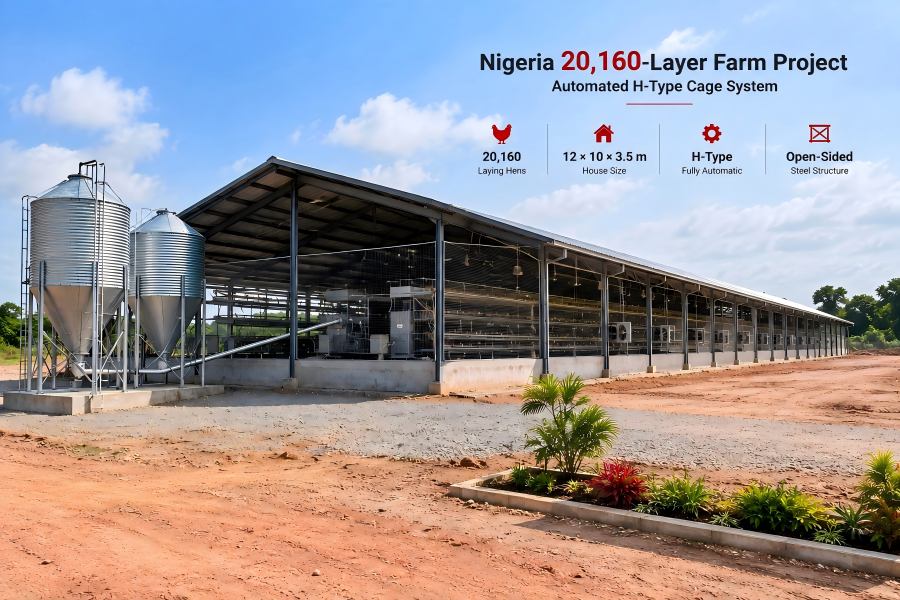
This project is located in Eket, Akwa Ibom State, Nigeria and is being developed as a new commercial layer farm rather than an equipment retrofit inside an existing building.
That distinction matters for cost planning.
When both the poultry house and cage system are being planned together, the investment is not simply:
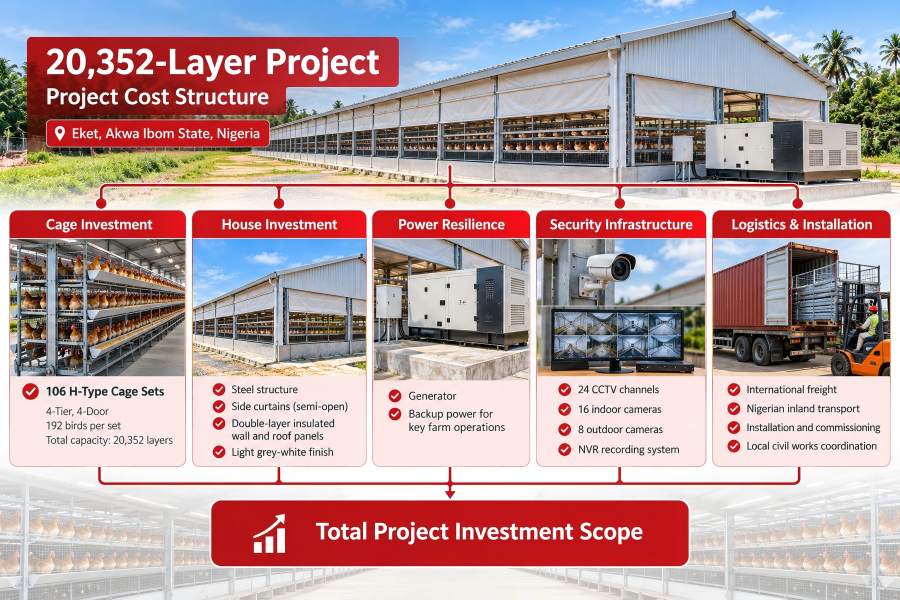
The real project boundary is wider:
| Project Item | Confirmed Configuration |
|---|---|
| Location | Eket, Akwa Ibom State, Nigeria |
| Bird Type | Layers |
| Target Capacity | 20,352 laying hens |
| Poultry House | New construction |
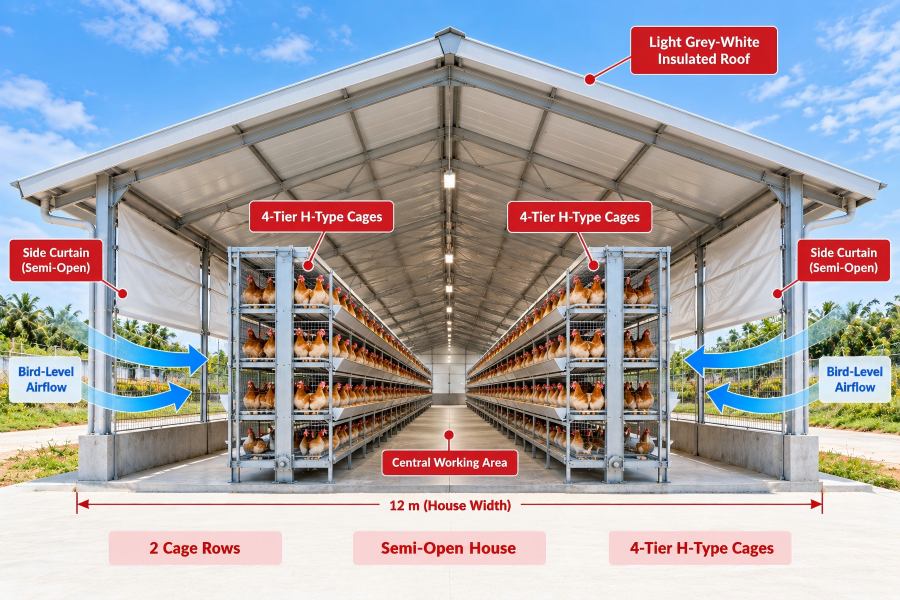
| House Size | 113 × 12 × 3.5 m |
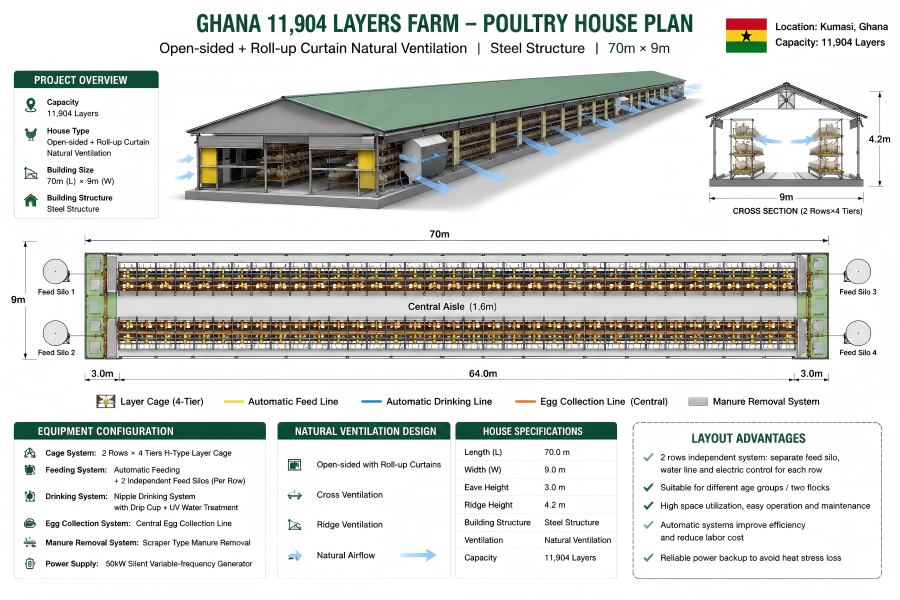
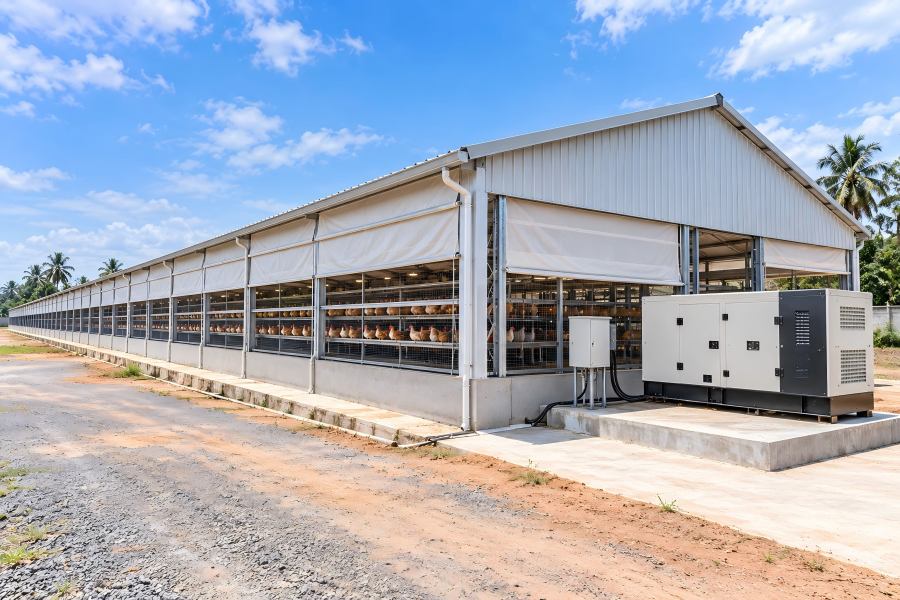
| House Structure | Semi-open steel structure with curtains |
| Wall & Roof | Double-layer panels with insulation; light grey-white finish |
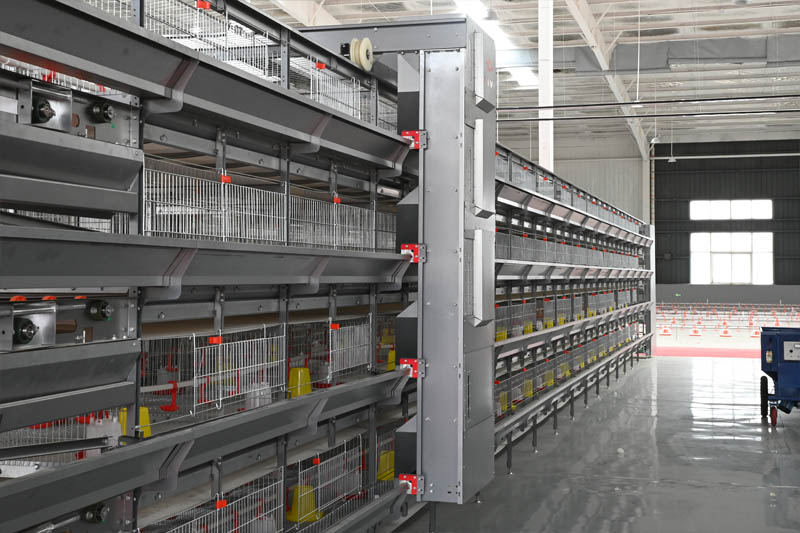
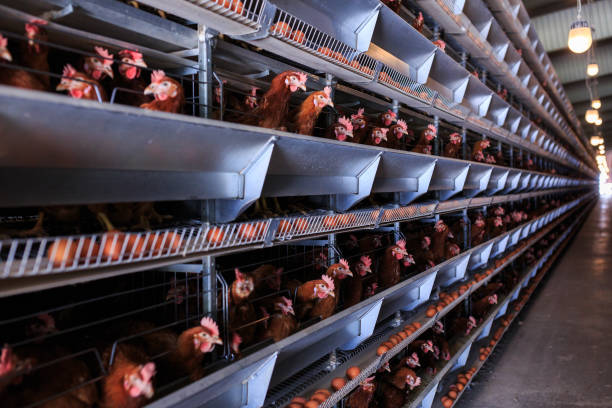
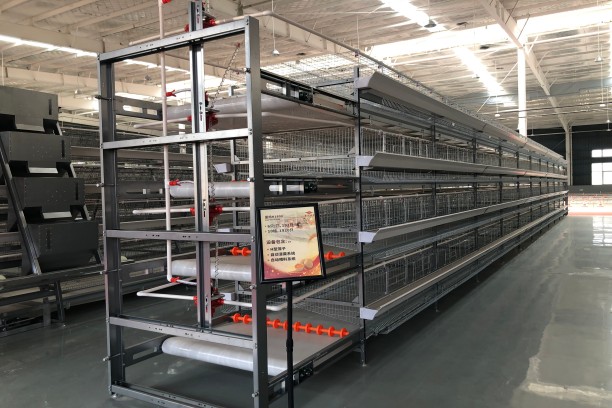
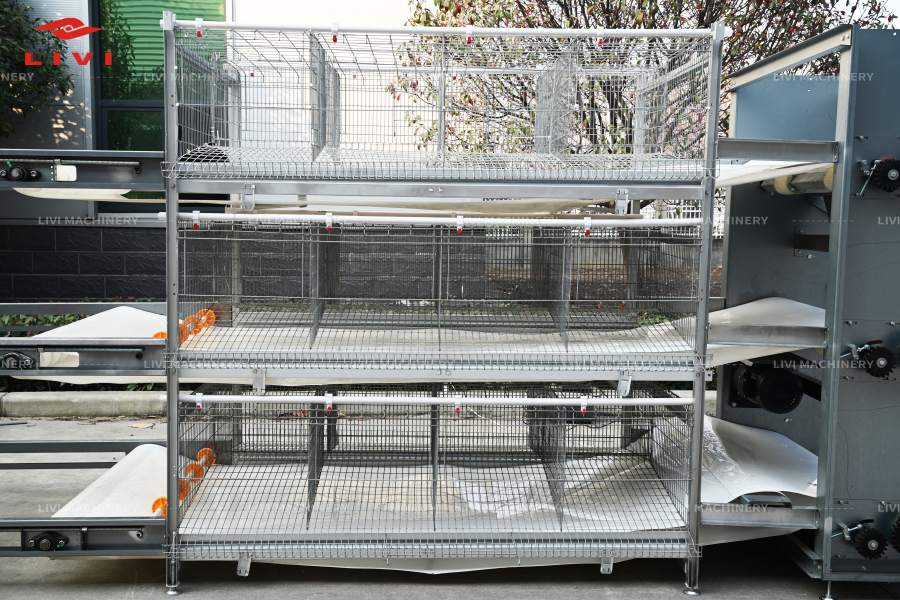
| Cage Type | H-Type Layer Cage |
| Cage Size | 1800 × 600 × 430 mm |
| Configuration | 4-Tier, 4-Door |
| Birds / Door | 6 |
| Birds / Set | 192 |
| Cage Rows | 2 |
| Sets / Row | 53 |
| Total Cage Sets | 106 |
| Backup Power | Generator |
| Security | 24-channel CCTV: 16 indoor + 8 outdoor, with NVR |
| Key Planning Challenges | High temperature and unstable power supply |
The confirmed project data provides a useful example for investors researching a 20,000-layer poultry farm in Nigeria: cage cost is only one part of the capital decision.
Why Does the Cage Calculation Matter to Project Cost?
One of the first checks in any poultry equipment quotation is whether the cage quantity actually matches the required flock capacity.
For this Eket project, the calculation is unusually clear.
53 sets / row × 2 rows = 106 sets
106 sets × 192 birds = 20,352 cage positions
The installed cage capacity therefore matches the target flock of 20,352 layers exactly.
This is important when buyers compare an H type layer cage price in Nigeria. A supplier quoting a lower total price may simply be quoting fewer cage sets, a different cage dimension, fewer birds per set or a different equipment scope.
The correct comparison starts by normalizing:
For this project, LIVI Machinery selected the 1800 × 600 × 430 mm H-frame configuration and organized the 106 sets into two longitudinal rows of 53 sets.
Buyers comparing H-frame configurations can also review the LIVI H-Type Layer Cage System to understand how cage dimensions, house layout and equipment interfaces need to be considered together.
Why a 113 × 12 m House Changes the Cost Discussion
The poultry house measures 113 m long, 12 m wide and 3.5 m high.
Its cost significance comes from more than floor area.
The project uses a semi-open steel structure with curtains, while the wall and roof specification includes double-layer panels with insulation and a light grey-white external finish.
These building decisions belong in the same investment analysis as the cage equipment because the local challenge is not simply housing 20,352 birds—it is operating that housing system under high-temperature conditions.
FAO guidance on poultry housing emphasizes bird-level airflow and notes that wider open-sided buildings become more difficult to ventilate using natural airflow alone.
The project house is 12 m wide. “Semi-open” should therefore not be interpreted as proof that natural ventilation alone will always provide adequate environmental control. Final airflow and ventilation requirements need to be checked against the actual cage density, local climate, building orientation and operating conditions.
This is particularly important when evaluating poultry house construction cost in Nigeria. Reducing the building quotation without checking thermal and airflow requirements can shift cost or risk into later operation.
What Actually Determines the Cost of This 20,352-Layer Project?
There is no verified total investment figure for this project, so publishing a fixed dollar or naira amount would be misleading.
Instead, the Nigeria 20,352 layer farm cost should be understood through its actual cost structure.
| Cost Layer | Confirmed or Relevant Scope | Buyer Question |
|---|---|---|
| Layer Housing | 106 H-type cage sets | Does the quotation provide all 20,352 cage positions? |
| Poultry House | 113 × 12 × 3.5 m new steel house | Is building construction included or locally sourced? |
| Building Envelope | Curtains + double-layer insulated panels | Are panel and insulation specifications included? |
| Power Resilience | Generator | Which loads must remain operational during an outage? |
| Security | 24 CCTV channels + NVR | Are cameras, recording equipment and installation included? |
| Logistics | Project-dependent | Does the price include international freight and Nigerian inland transport? |
| Installation | Project-dependent | What installation guidance, labor and local materials are included? |
This explains why searches such as poultry equipment price in Nigeria or battery cage price in Nigeria cannot be answered responsibly with one number.
A cage-only quotation, a cage-plus-house quotation and a complete farm infrastructure quotation represent three different investment boundaries.
For a broader cost framework, buyers can review LIVI’s battery cage poultry farm cost guide.
Planning a 20,000-Layer Farm in Nigeria?
Send LIVI your target capacity, proposed poultry-house dimensions, location and required equipment scope. We can define the cage layout first so you can compare project costs on the same basis.
Why Backup Power Is Part of the Investment—Not an Optional Extra
Unstable electricity was identified as one of the project’s planning problems, so a generator is included in the confirmed project scope.
This is a significant cost-planning point for a commercial layer farm.
World Bank Enterprise Survey data has documented electricity outages among Nigerian businesses and also tracks generator ownership and generator-supplied electricity. This does not determine the electrical design of a poultry farm, but it supports treating power resilience as a real infrastructure planning issue in Nigeria.
For this project, however, the confirmed information only states generator.
No generator kVA, fuel consumption, daily operating hours or automatic transfer arrangement has been confirmed. Those values should not be invented.
How Should Generator Size Be Determined?
A buyer searching for generator size for poultry farm Nigeria should start with a load schedule rather than bird capacity:
This separates a real engineering calculation from a generic “generator per 20,000 birds” estimate.
Why Include 24-Channel CCTV in a Poultry Farm Cost Plan?
The project includes a 24-channel CCTV system consisting of 16 indoor cameras, 8 outdoor cameras and an NVR.
This should be treated as a confirmed infrastructure item rather than hidden inside a generic “farm equipment” budget.
| Security Scope | Confirmed Quantity |
|---|---|
| Indoor CCTV | 16 channels |
| Outdoor CCTV | 8 channels |
| Total | 24 channels |
| Recording | NVR |
The cameras can support site observation and security management, but CCTV should not be presented as a substitute for poultry-farm biosecurity.
WOAH recommends written biosecurity procedures for intensive poultry establishments, including measures to reduce the introduction and spread of infectious agents.
For an investor, this means security monitoring and biological risk control should be budgeted and managed as different functions.
How Should Buyers Compare an H-Type Layer Cage Quotation in Nigeria?
When comparing a layer cage price in Nigeria, start with the physical specification rather than the supplier’s headline price.
- Is the cage size 1800 × 600 × 430 mm?
- Is it a 4-tier, 4-door configuration?
- Is the stocking basis 6 birds per door?
- Does each set provide 192 cage positions?
- Are all 106 cage sets included?
- Does the layout show 2 rows × 53 sets?
- Which supporting systems are included or excluded?
- What is supplied by the manufacturer and what must be sourced locally?
- What freight, installation and commissioning terms apply?
- Which spare parts and after-sales services are included?
This is especially important when buyers compare a Chinese poultry equipment manufacturer or poultry equipment supplier in Nigeria. The lowest factory price is not necessarily the lowest landed or installed project cost.
Buyers should separate:
This provides a more useful basis for evaluating poultry equipment landed cost Nigeria than comparing cage price alone.
What Can Other 20,000-Layer Investors Learn from the Eket Project?
The main lesson is that the equipment decision should follow the farm’s constraints.
For this project, the planning sequence can be summarized as:
This differs from another 20,000-layer farm that may already have a building, use A-type cages or operate with a different power strategy.
For comparison, buyers can review another Nigeria 20,000-layer A-type cage project, where the farm structure and mechanization strategy are different.
LIVI Machinery therefore does not treat “20,000 layers” as a complete design brief. House dimensions, climate, electricity, automation expectations and investment boundaries still need to be defined before a meaningful quotation can be prepared.
Comparing H-Type Cage Prices in Nigeria?
Send LIVI the same capacity, house dimensions and required system scope you are using for other quotations. This makes it easier to compare cage quantity, infrastructure and equipment costs on an equivalent basis.
What Information Is Still Needed Before a Final Project Cost Can Be Confirmed?
The cage quantity is confirmed, but that does not mean the complete farm budget is already known.
A responsible final quotation still needs to define the commercial and engineering boundaries that have not been provided in this case brief.
| Input | Why It Matters to Cost |
|---|---|
| Automation Scope | Feeding, drinking, egg collection and manure handling can materially change equipment scope. |
| Ventilation Design | High temperature and the 12 m house width require project-specific environmental evaluation. |
| Generator Load | Determines backup-power specification rather than selecting generator size from bird count. |
| Local Civil Works | Foundations, drainage and site preparation affect installed cost. |
| Shipping Destination | Required to estimate freight and Nigerian inland logistics. |
| Installation Boundary | Defines supplier, local contractor and customer responsibilities. |
Frequently Asked Questions About This Nigeria Layer Farm
1. How much does a 20,000-layer poultry farm cost in Nigeria?
There is no reliable fixed price based only on 20,000 birds. The total investment depends on poultry-house construction, cage specification and quantity, automation, ventilation, backup power, security, freight, installation and local infrastructure. No verified total investment has been provided for this Eket project, so this case does not publish an invented project price.
2. How many H-type cage sets are required for 20,352 layers in this project?
The project uses 106 sets. Each 4-tier, 4-door H-type cage set accommodates 192 layers. Therefore, 106 × 192 = 20,352 cage positions.
3. What is the H-type layer cage specification?
The confirmed cage size is 1800 × 600 × 430 mm, configured as 4 tiers × 4 doors with 6 birds per door and 192 birds per cage set.
4. What generator size is required for a 20,000-layer farm in Nigeria?
Generator size should not be selected from bird capacity alone. The electrical loads, motor starting requirements, simultaneous operation and essential backup circuits must first be calculated. A generator is confirmed for this project, but its power rating has not been provided.
5. Is a semi-open poultry house suitable for a hot climate?
A semi-open design can provide access to natural airflow, but house width, cage arrangement, local temperature, humidity and wind conditions all affect actual ventilation. Because this house is 12 m wide, final airflow requirements should be checked rather than assuming open sides alone are sufficient.
6. What should I compare when checking H-type layer cage prices in Nigeria?
Compare cage dimensions, tiers, doors, birds per set, total cage quantity, material specification, included supporting systems, shipping terms, installation scope, spare parts and after-sales support. Quotations with different supply scopes should not be compared only by total price.
7. What information should I send LIVI for a poultry equipment quotation?
Provide your country and project location, target bird capacity, poultry-house dimensions or available land, preferred cage type if known, required automation level, power conditions and expansion plan. These inputs allow LIVI to prepare a more project-specific layout and quotation.
Planning the Cost of a Commercial Layer Farm in Nigeria?
This Eket project shows why a commercial layer farm should be costed as an integrated project rather than as a cage purchase.
For this farm, the confirmed cage calculation is exact: 106 H-type cage sets × 192 birds = 20,352 layer positions. The next step in a complete investment analysis is to define the remaining equipment, environmental-control, electrical and implementation boundaries without filling those gaps with assumptions.
Build Your Nigeria Layer Farm Cost Plan
Send LIVI your project location, target bird capacity, poultry-house dimensions and required automation level. LIVI Machinery can prepare a cage layout and equipment scope for a project-specific cost and quotation comparison.